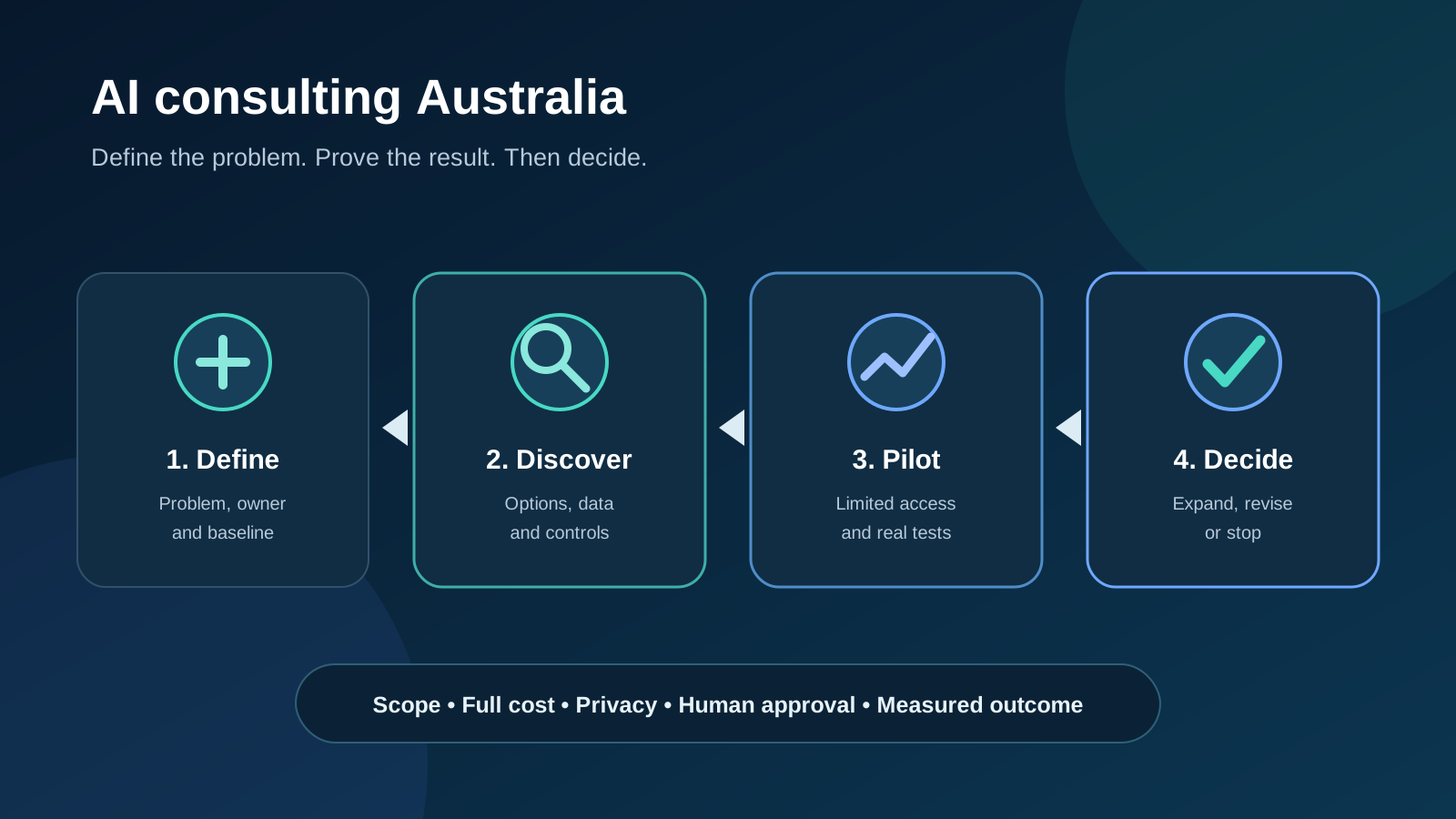
AI consulting in Australia should help a business choose a useful AI opportunity, test it safely and turn it into a working process. For most small and medium businesses, the best engagement is a fixed-scope discovery followed by one controlled pilot. Avoid open-ended strategy work that has no owner, baseline, build path or acceptance test.
A consultant should leave you with better decisions and an operating result, not just a presentation. The scope should state what will be assessed, what will be built, what remains your responsibility and how the business will decide whether to continue.
Key takeaways:
- Start with a business problem and baseline, not a preferred AI product.
- Separate discovery, pilot, software and ongoing support costs.
- Require a named path from advice to implementation.
- Check data access, privacy, testing and human approval before a pilot.
- Use measured pilot results to expand, revise or stop the work.
Contents
- What does an AI consultant do?
- When should a business hire an AI consultant?
- What does AI consulting cost in Australia?
- What should the consulting process include?
- How do you compare AI consulting proposals?
- What privacy and security checks matter?
- How should you measure an AI pilot?
- When is AI consulting the wrong choice?
- Frequently asked questions
What does an AI consultant do?
An AI consultant assesses business processes, identifies suitable uses for AI and recommends how to implement them. Depending on the engagement, they may also map data, select products, design controls, build a pilot, train staff and support the system after launch.
The title does not guarantee a particular deliverable. Some consultants focus on strategy and governance. Others configure established products, build integrations or manage working systems. Confirm the output before comparing providers.
| Provider type | Best suited to | Typical output | Gap to check |
|---|---|---|---|
| AI strategy consultant | Priorities, policy and investment decisions | Assessment and roadmap | Who turns the roadmap into a working system? |
| Product specialist | A need that fits one established platform | Configuration and product training | Is the advice tied to one vendor? |
| Data or machine learning consultancy | Custom models, forecasting or complex data work | Data pipeline, model or technical system | Who manages adoption and daily operation? |
| AI implementation provider | A defined workflow across approved systems | Tested workflow, training and documentation | What support follows handover? |
| Managed AI provider | Implementation plus continuing operation | Working system with monitoring and support | What is included in the monthly scope? |
A business may need more than one role, but it should not pay twice for the same discovery work. Ask one party to own the delivery plan and identify every handover.
If the main need is selecting a delivery partner rather than scoping the engagement, read our guide to choosing AI experts in Australia.
When should a business hire an AI consultant?
Hire an AI consultant when the business has a repeated problem worth solving but lacks the internal time or skills to assess tools, data, risk and implementation. The problem should have an owner and a result that can be measured before any work begins.
Useful starting conditions include:
- staff repeatedly move the same information between systems
- customer enquiries wait because sorting and drafting are manual
- standard documents take too long to prepare and check
- teams use unapproved AI tools without consistent rules
- several vendors appear suitable and the business needs independent assessment
- a planned AI use involves personal information or consequential decisions
The latest Australian Government AI Adoption Tracker update reported that 41% of small and medium enterprises were adopting AI. It also reported that 22% saw faster decision-making and 18% highlighted productivity improvements. These figures show active adoption, but they do not prove that every process benefits from AI.
Before engaging a consultant, write a short problem statement. For example: “Two staff spend a combined 18 hours each week reading service enquiries, requesting missing details and assigning work. We want to reduce handling time without allowing AI to send commitments or pricing.”
That statement gives a consultant something testable. “Develop an AI strategy” does not.
What does AI consulting cost in Australia?
AI consulting costs in Australia vary with the scope, seniority, data readiness, integrations, risk and support required. Providers may charge a fixed project fee, a daily rate, a monthly retainer, usage charges or a combination. Compare the total cost to a defined result rather than choosing the lowest headline rate.
A useful proposal separates these cost areas:
| Cost area | What it should cover | Common omission to check |
|---|---|---|
| Discovery | Process mapping, baseline, data review and prioritisation | Staff time needed from your business |
| Solution design | Workflow, permissions, approvals and product selection | Security or privacy assessment |
| Pilot | Configuration, integrations, testing and corrections | Edge cases and failure testing |
| Software and usage | Platform licences, model usage and connected services | Charges that increase with volume |
| Training and handover | Role-based training, operating guide and ownership | Training for new staff later |
| Ongoing support | Monitoring, incidents, changes and vendor updates | Response times and change limits |
| Exit | Data export, account transfer and documentation | Rebuilding vendor-owned configurations |
Do not ask for a fixed implementation price before the provider understands the process and systems involved. A short fixed-scope discovery can reduce uncertainty for both sides. It should end with a written recommendation, solution outline, risk register, pilot plan and priced next step.
For most small and medium businesses, this staged model is better than a large open-ended program. It creates a decision point before the business commits to a broader build.
What should the consulting process include?
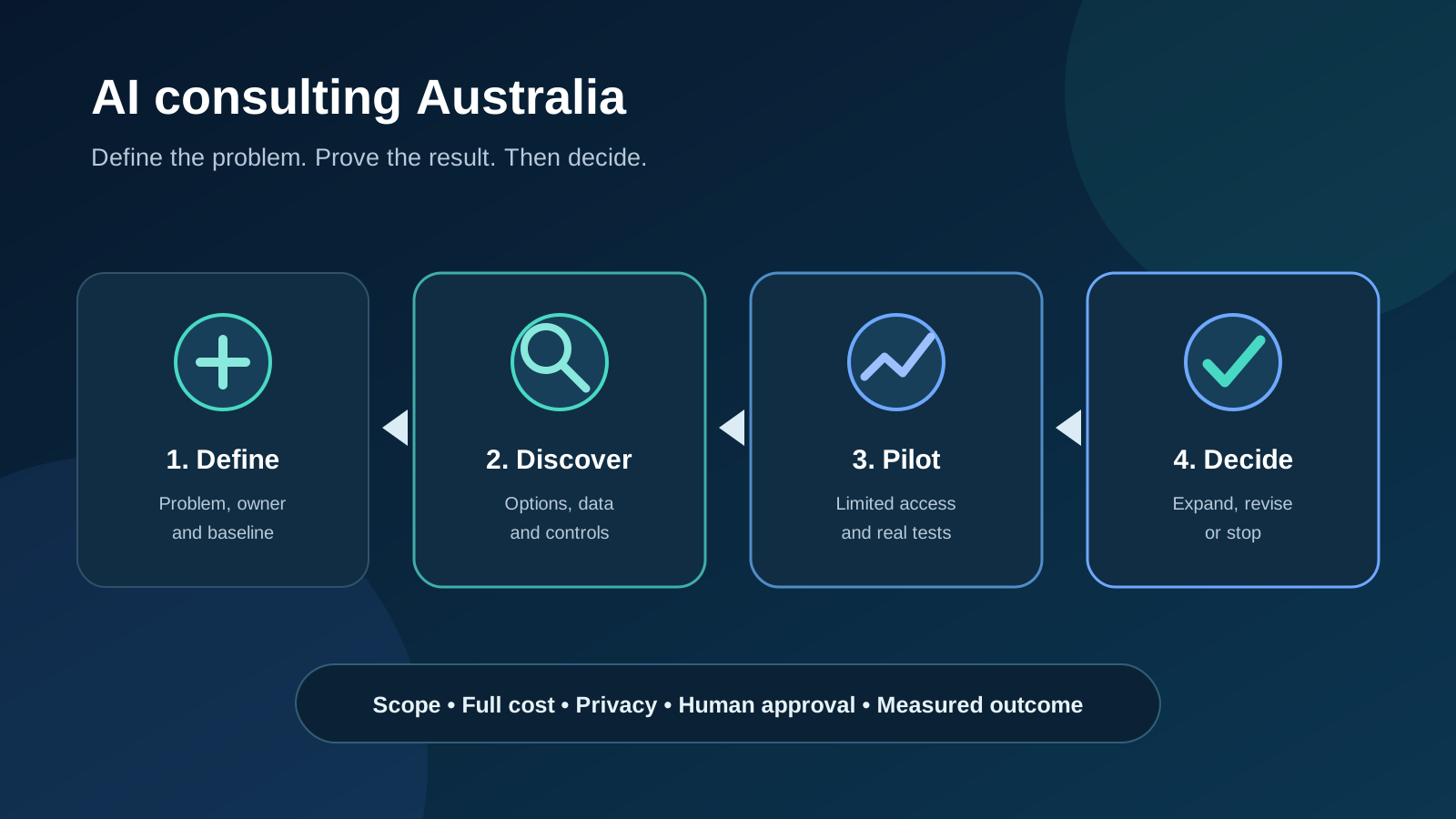
A useful AI consulting process moves through four stages: define, discover, pilot and decide. Each stage should have a named owner and completion test.
1. Define the business problem
Record the current process, frequency, staff time, delays, rework and errors. Name the process owner and the decisions that must remain with a person. Agree on the baseline before changing the workflow.
2. Discover the practical options
The consultant should map the information, systems, users and exceptions involved. They should compare AI with simpler alternatives, including a feature already available in your software or a rules-based automation.
Discovery should answer:
- What outcome is worth improving?
- Which information is genuinely required?
- Can current software solve the problem?
- Where could AI be uncertain or wrong?
- Which actions need approval?
- What must be tested before real use?
- Who operates and supports the result?
3. Run one controlled pilot
The pilot should cover one workflow and a limited group of users. Use the minimum system access required. Keep the existing process available until the new workflow meets its acceptance criteria.
Test routine cases, missing information, conflicting inputs, outages and unsafe requests. Staff should be able to see the source behind important outputs and stop the workflow when something fails.
4. Decide from evidence
Compare pilot results with the baseline. Include correction time, incidents and staff effort, not just the time taken by the AI step. Choose whether to expand, revise or stop.
A strong consultant is willing to recommend stopping. The purpose of a pilot is to learn whether the full operating case works, not to justify a decision already made.
Our guide to an AI audit for business provides a practical way to inspect workflows, data and controls before implementation.
How do you compare AI consulting proposals?
Compare proposals with a weighted scorecard based on your problem. Do not award extra points for a longer list of tools or technical terms.
| Criterion | Weight | Evidence to request |
|---|---|---|
| Understanding of the workflow | 20% | Current-state map, exceptions and named owner |
| Delivery path | 20% | Defined outputs from discovery through pilot and support |
| Data, privacy and security | 20% | Data flow, access model, retention and incident responsibilities |
| Testing and human control | 15% | Test cases, acceptance criteria, approvals and fallback |
| Relevant delivery evidence | 10% | Comparable work, references or a working demonstration |
| Commercial clarity | 10% | Inclusions, assumptions, licences, usage and change costs |
| Handover and exit | 5% | Documentation, training, data export and account ownership |
Adjust the weights for your risk and business needs. A regulated service may place more weight on governance. A narrow internal workflow may place more weight on delivery speed and integration fit.
Ask every shortlisted provider the same questions:
- What will exist at the end of each stage?
- Who will do the work after the sales meeting?
- Which assumptions could change the price or schedule?
- Which systems and data will the pilot access?
- How will you test incorrect and manipulated inputs?
- What will our staff need to operate each week?
- What can we export or keep if the relationship ends?
The best proposal is usually the one that narrows the first commitment while making later costs and responsibilities visible.
What privacy and security checks matter?
Privacy and security checks should happen during discovery, before real business information enters an AI product. Map what the system receives, where it is processed, who can access it, how long it is retained and whether a provider may use it to train a model.
The Office of the Australian Information Commissioner says privacy obligations apply to personal information entered into AI systems and generated outputs containing personal information. Its guidance recommends due diligence, privacy by design, human oversight and regular review. It also recommends not entering personal or sensitive information into publicly available generative AI tools as a matter of best practice.
Australia's Voluntary AI Safety Standard sets out 10 guardrails covering accountability, risk management, data, testing, human oversight and transparency. Ask the consultant to show how relevant guardrails appear in the design and operating documents rather than merely listing the standard in a proposal.
The Australian Signals Directorate identifies three broad cyber risks for small businesses using cloud AI: data leaks and privacy breaches, unreliable or manipulated outputs, and supply-chain vulnerabilities. Its AI guidance for small business recommends reviewing vendor data practices, limiting sensitive information, verifying outputs and keeping people involved in high-stakes work.
Require clear answers on:
- business and vendor account ownership
- role-based access and multifactor authentication
- model-training settings and subprocessors
- storage, processing and backup locations
- logging of user, system and AI actions
- testing for unreliable or manipulated inputs
- incident notification and workflow shutdown
- retention, deletion and export procedures
A consultant can help design controls, but the business remains accountable for its use of AI. Seek legal, privacy or cyber security advice where the risk warrants it.
How should you measure an AI pilot?
Measure the whole workflow before and after the pilot. A fast model response does not matter if staff spend more time checking and correcting it.
Useful measures include:
- handling time per case
- waiting time before work begins
- percentage of outputs accepted without correction
- number and type of corrections
- exceptions returned to a person
- missed, duplicated or wrongly updated records
- staff time spent supervising the workflow
- customer or staff complaints
- privacy, security and access incidents
- software, usage and support cost per completed case
Set acceptance thresholds before the pilot. For example, the business might require every outgoing customer message to receive human approval, 100% of source links to open correctly and no write access beyond two approved CRM fields.
Review performance by case type, not just an average. A workflow can look accurate while failing on unusual or high-value cases. Keep a record of test cases and repeat them after product, model or process changes.
For most businesses, the right next step is expansion only after the pilot is stable, staff understand it and the measured benefit exceeds the full operating cost.
When is AI consulting the wrong choice?
AI consulting is the wrong choice when the business cannot name the problem, process owner or desired result. Paying someone to search broadly for an AI use can produce a generic roadmap that nobody implements.
Choose a simpler option when:
- existing software already has a suitable feature
- the task follows fixed rules and does not need AI
- the work happens too rarely to recover setup and support costs
- the source information is incomplete or unreliable
- no staff member can own testing and operation
- the business is unwilling to limit access or keep human review
You may also need a different provider. A strategy consultant is a poor fit when the scope is already clear and you need a build. A product specialist is a poor fit when the business needs independent vendor selection. A large consultancy can be excessive for one contained workflow.
A responsible consultant should identify these limits before proposing more work.
Frequently asked questions
What is AI consulting?
AI consulting is professional advice and delivery support for selecting, designing, governing or implementing artificial intelligence in a business. The work may include process assessment, product selection, data review, pilot delivery, staff training and ongoing support.
How much does AI consulting cost in Australia?
The cost depends on the scope, seniority, data readiness, integrations, risk and support required. Compare separate prices for discovery, pilot delivery, software, usage, training and ongoing support, then assess the total against a measured business result.
How do I choose an AI consultant in Australia?
Define one business problem and compare providers with the same brief. Ask for clear deliverables, relevant delivery evidence, a data-flow explanation, test criteria, human approval points, full costs and exit terms.
What should an AI consulting engagement deliver?
A useful engagement should deliver a documented problem, current baseline, ranked options, solution outline, risk controls and a practical next step. If implementation is included, it should also deliver a tested workflow, training, operating documentation and agreed support responsibilities.
Is an AI consultant different from an AI automation agency?
An AI consultant may focus on assessment, strategy and governance, while an AI automation agency is generally expected to build workflows across business systems. The labels overlap, so compare the written scope and named responsibilities rather than relying on the title.
Start with one decision, not an AI wish list
A good consulting engagement reduces uncertainty. It helps the business decide which problem deserves investment, which controls it needs and whether a pilot performs well enough to continue.
Deployed AI provides managed AI systems for Australian businesses, including selected integrations, setup, team training and ongoing Australian support. Book a free 30-minute AI audit to assess one workflow before committing to a larger AI program.