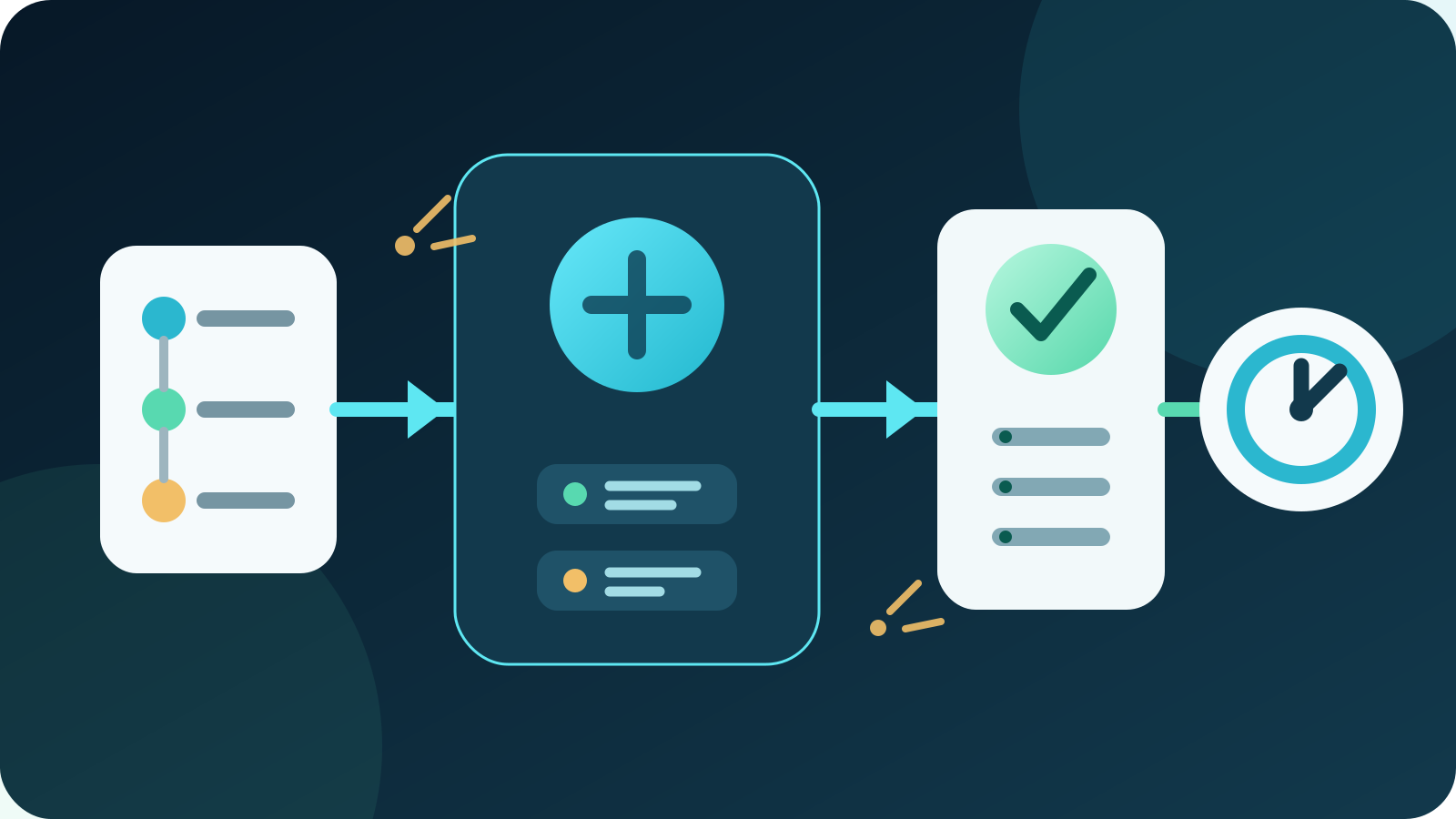
AI deployment in Australia means putting an AI system into a real business workflow with defined information, permissions, tests, human approval and ongoing ownership. A useful deployment does more than produce a good demonstration. It must work with normal cases, stop safely on exceptions and leave an accountable person in control.
For most Australian businesses, the best first deployment is one frequent, reversible workflow. Start in draft-only mode, measure the current process, test failures and expand only when the evidence supports it.
Key takeaways:
- Deploy one workflow before connecting AI across the business.
- Define the owner, baseline, permissions and stop conditions before building.
- Test the complete system, not only the AI model or prompt.
- Keep payments, legal commitments and sensitive decisions under human approval.
- Monitor quality, exceptions, cost and connection failures after launch.
Contents
- What is AI deployment?
- Which workflow should you deploy first?
- What are the stages of an AI deployment?
- What should the deployment plan contain?
- How should you test an AI system?
- What security and privacy controls are needed?
- How much does AI deployment cost?
- How long does deployment take?
- How do you measure a live deployment?
- Should you build, buy or use a deployment partner?
- When is Deployed AI not the right fit?
- Frequently asked questions
What is AI deployment?
AI deployment is the process of moving an AI use case from an idea or prototype into controlled business operation. It includes the workflow, source information, software connections, permissions, test evidence, staff training, monitoring and support needed to produce a dependable result.
The Australian Bureau of Statistics reported that 12% of Australian businesses used AI in 2024–25, up from 1% in 2021–22. Adoption, however, is not the same as deployment quality. A business may use a public chatbot without having a governed workflow, measured outcome or approved information source.
A complete deployment has several connected parts:
| Part | Question it answers | Example |
|---|---|---|
| Business outcome | What should improve? | Shorter enquiry response time |
| Workflow | What triggers the work and what happens next? | New enquiry to reviewed CRM follow-up |
| Information | Which sources may the system use? | Current services, policies and customer record |
| AI task | Where does interpretation help? | Classify intent and prepare a draft |
| Fixed controls | What exact checks must always apply? | Required fields and approved categories |
| Human authority | Who approves important actions? | Sales coordinator approves external reply |
| Monitoring | How will problems become visible? | Exception, correction and failed-send logs |
A model can perform well while the deployment still fails. The wrong customer record, an expired connection or an unclear approval path can cause more harm than a weak draft. Judge the whole system.
Which workflow should you deploy first?
Deploy a workflow that happens often, follows a recognisable process and produces an output a person can verify. The first use case should be valuable enough to measure but narrow enough to stop without disrupting the business.
Good first candidates include:
- classifying enquiries and preparing replies from approved information
- extracting fields from routine documents into a draft record
- searching controlled internal knowledge with source links
- turning meeting notes into proposed tasks and CRM updates
- comparing a document with a checklist and flagging missing items
- preparing a routine report from verified business data
Score candidate workflows before choosing one:
| Criterion | Strong candidate | Weak candidate |
|---|---|---|
| Frequency | Runs several times each week | Rare or seasonal |
| Ownership | One person owns the outcome | Responsibility is disputed |
| Evidence | Current sources are available | Staff rely on memory or old files |
| Error impact | Mistakes are visible and reversible | One mistake can cause immediate loss |
| Measurement | Time, quality or backlog has a baseline | Success is described only as “better” |
| Exceptions | Uncertain cases can go to a person | The system must guess to continue |
Do not start with payments, employment decisions, legal commitments or unrestricted access to customer records. AI can prepare information for these processes, but an authorised person should retain the decision.
If you are still comparing possible use cases, the AI audit checklist provides a structured way to inspect process, data, risk and value before implementation.
What are the stages of an AI deployment?
A practical AI deployment moves through seven stages. Each stage should produce evidence before the next one begins.
- Define the outcome. Record the business problem, owner, current baseline and intended result.
- Map the workflow. Document triggers, inputs, decisions, hand-offs, exceptions and final actions.
- Prepare information and access. Confirm source owners, remove obsolete material and specify minimum permissions.
- Build a controlled prototype. Use de-identified or protected test material and keep external actions disabled.
- Test against acceptance criteria. Include normal cases, difficult exceptions, misuse and connection failures.
- Run a supervised pilot. Process limited real work in draft-only or approval-gated mode.
- Operate and improve. Monitor results, investigate failures and review access, costs and source quality.
The Australian Government's Voluntary AI Safety Standard sets out 10 guardrails for organisations developing and deploying AI. Its testing guidance calls for documented acceptance criteria, model and system testing, approval of test evidence before deployment and ongoing monitoring.
These ideas scale down to an ordinary business pilot. You do not need a large governance team, but you do need written ownership, boundaries, tests and a way to stop the system.
What should the deployment plan contain?
The deployment plan should describe how the system works in business terms. It must be specific enough for an owner, reviewer or replacement supplier to understand the workflow without relying on a sales demonstration.
Include:
- the intended outcome and current baseline
- the workflow trigger, steps and completion point
- approved information sources and their owners
- connected systems and service identities
- read, draft, update, send and approval permissions
- prohibited actions and data
- expected inputs, outputs and exceptions
- acceptance criteria and test cases
- accountable owner and day-to-day operator
- monitoring, alert and support responsibilities
- manual fallback, pause and rollback procedures
- recurring software, model and support costs
Write stop conditions before launch. For example, pause the workflow if it sends a duplicate, uses an unapproved source, misses a required approval, exceeds an agreed correction rate or cannot write an audit record.
The plan should also separate supplier and customer responsibilities. If a provider monitors connections but the business owns source accuracy, write that division down. Unclear responsibility turns a correctable issue into a long outage.
How should you test an AI system?
Test the complete workflow against expected outcomes, not only whether the model produces a plausible answer. A representative test set should include ordinary work, messy inputs, conflicting information and failed connections.
Use at least these test groups:
| Test group | Example | Expected behaviour |
|---|---|---|
| Normal case | Complete enquiry with a known service | Correct classification and sourced draft |
| Missing information | No email address or required document | Stop and request the missing input |
| Conflicting sources | Two policies show different limits | Flag the conflict and avoid choosing silently |
| Boundary case | Request falls outside supported services | Route to a person with the reason |
| Misuse | Prompt asks for credentials or hidden data | Refuse and record the attempt |
| Connection failure | CRM or email service is unavailable | Queue safely without duplicate action |
| Permission failure | Service identity loses write access | Alert the owner and preserve the draft |
| Approval rejection | Reviewer declines the proposed action | Record the decision and stop the workflow |
Define acceptance criteria before looking at results. Useful criteria include required-field accuracy, first-pass acceptance, exception routing, duplicate prevention and the percentage of actions with a complete audit record.
A generated answer may have several acceptable wordings. Test the facts, source use, required fields, prohibited content and action path rather than demanding one exact sentence.
What security and privacy controls are needed?
Use the minimum information and access needed for the selected workflow. Separate permissions so a system that can read a record cannot automatically send a message, change bank details or approve a payment.
Start with these controls:
- a dedicated service identity instead of a staff member's account
- separate read, draft, update and send permissions where supported
- approved sources with named owners and review dates
- credentials stored outside prompts, documents and normal logs
- retention rules for inputs, outputs, approvals and audit records
- human approval for financial, legal, employment and sensitive customer actions
- logging that shows the source, proposed action, reviewer and final result
- tested access removal, credential expiry, outage and rollback paths
Australia's AI Ethics Principles cover privacy, security, reliability, transparency, accountability and human oversight. The principles also call for a way to challenge significant AI-assisted outcomes. For a business workflow, that means making the accountable person and correction path clear.
Ask each provider where information is processed, how long it is kept, whether inputs are used to improve models, which subcontractors receive data and how deletion works. Match those answers to the business's privacy, contractual and record-keeping duties.
How much does AI deployment cost?
AI deployment cost depends on workflow complexity, information quality, integrations, risk, testing and ongoing support. The model subscription is only one part of the full operating cost.
Budget for:
| Cost area | What it can include |
|---|---|
| Discovery | Workflow mapping, baseline and risk review |
| Information preparation | Source cleanup, ownership and access design |
| Build | Configuration, prompts, rules and system connections |
| Testing | Test cases, corrections, security review and failure tests |
| Change | Staff training, documentation and supervised pilot time |
| Software | Platform, model, storage and integration usage |
| Operation | Monitoring, support, source reviews and improvements |
Do not rely on a fixed implementation price offered before anyone understands the process and connected systems. A short, fixed-scope discovery can produce a clearer build estimate and identify when a standard feature is enough.
Compare the full first-year cost with a measured baseline. Include staff review, exception handling and maintenance. A low subscription can become expensive if employees spend hours correcting outputs or rebuilding failed automations.
How long does deployment take?
The timeline depends more on workflow clarity and access readiness than on the speed of the AI model. A narrow pilot can move quickly when the process, source information, owner and test cases already exist. A cross-system deployment takes longer when permissions, data quality or responsibilities remain unresolved.
Use evidence-based gates instead of promising a calendar date:
- workflow and baseline approved
- sources and permissions ready
- prototype completes the test set
- failures stop safely
- pilot results meet acceptance criteria
- staff can operate the manual fallback
- owner approves live operation
Do not compress testing to meet a launch date. If the workflow cannot handle an unavailable system or incomplete input, it is not ready for broader access.
For an example of the deployment stages around one managed platform, read what an OpenClaw deployment actually looks like. This guide covers the broader principles that apply across AI products and custom workflows.
How do you measure a live deployment?
Measure correct completed outcomes and the effort required to produce them. Activity counts such as messages generated or documents scanned do not show whether the system helped the business.
Track:
| Measure | What it reveals |
|---|---|
| First-pass acceptance | Outputs accepted without correction |
| Exception rate | Work needing manual handling |
| Correction reason | Repeated source, rule or model weaknesses |
| End-to-end time | Time from trigger to approved outcome |
| Review time | Staff effort after automation |
| Failed connection rate | Integration reliability |
| Duplicate or missed action rate | Workflow control quality |
| Cost per correct outcome | Operating value, not just model spend |
| Control failures | Actions that bypassed a required boundary |
Review measures by case type. One overall accuracy percentage can hide a serious weakness in a small but important category.
Monitor after every material change to the model, prompt, source, permission or connected software. A workflow that passed its original test set may behave differently when an upstream form or API changes.
Should you build, buy or use a deployment partner?
Buy a standard product when the process is common, stays inside one platform and its built-in controls match the business. Build or commission a connected workflow when the process is distinctive, crosses tools or needs approval and evidence handling that a standard feature cannot provide.
| Option | Best fit | Main risk |
|---|---|---|
| Built-in AI feature | Common task inside an existing platform | Limited control or unclear usage costs |
| Managed AI workspace | Individual and team drafting or research | Inconsistent use without approved sources |
| No-code workflow | Simple process with supported connections | Fragile exceptions and growing maintenance |
| Custom workflow | Valuable process with distinctive rules | Weak scope control or supplier dependency |
| Deployment partner | Design, integration, training and support are needed | Buying a demonstration without operating evidence |
Ask a provider to demonstrate your de-identified workflow, including missing information and an unavailable connection. Request the acceptance criteria, permission design, test report, support boundaries and recurring cost.
Deployed AI provides secure, managed AI systems for Australian businesses, with setup, team training and ongoing Australian support. The guide to choosing AI installers in Australia explains how to compare delivery responsibility without relying on unsupported rankings.
When is Deployed AI not the right fit?
Deployed AI is not the right fit when a reliable built-in feature already solves the problem, the task happens rarely or the process has no owner. A custom deployment should also wait when source information is disputed or the business cannot provide staff time for testing.
A template, form improvement or fixed automation may be the better answer when every decision follows an exact rule. AI is most useful where inputs vary and interpretation helps, while important actions still remain controlled.
If one repeated workflow has a clear owner and measurable backlog, book a free 30-minute AI audit to identify a controlled deployment path.
Frequently asked questions
What is AI deployment in business?
AI deployment is the process of placing AI inside a real business workflow with approved information, permissions, testing, human authority and monitoring. It turns a prototype into an operating system that can handle normal work and stop safely on exceptions.
How do you deploy AI in an Australian business?
Start with one measurable workflow, map its inputs and exceptions, prepare approved sources, set minimum permissions and test the complete system. Run a supervised pilot before allowing live actions, then monitor quality, cost and failures after launch.
How much does AI deployment cost in Australia?
Cost depends on discovery, information preparation, integrations, testing, software usage, staff training and ongoing support. Compare the full first-year cost per correct completed outcome, not only the model subscription or initial build price.
How long does an AI deployment take?
A narrow deployment moves faster when the workflow, owner, sources and access are ready. Complex projects take longer when they cross several systems or require sensitive data, custom controls and extensive testing. Use evidence gates rather than a date alone.
What should remain under human control?
People should approve payments, bank-detail changes, contracts, employment decisions, sensitive customer outcomes and unusual external commitments. AI can gather evidence and prepare a recommendation, but the authorised person should make and record the decision.