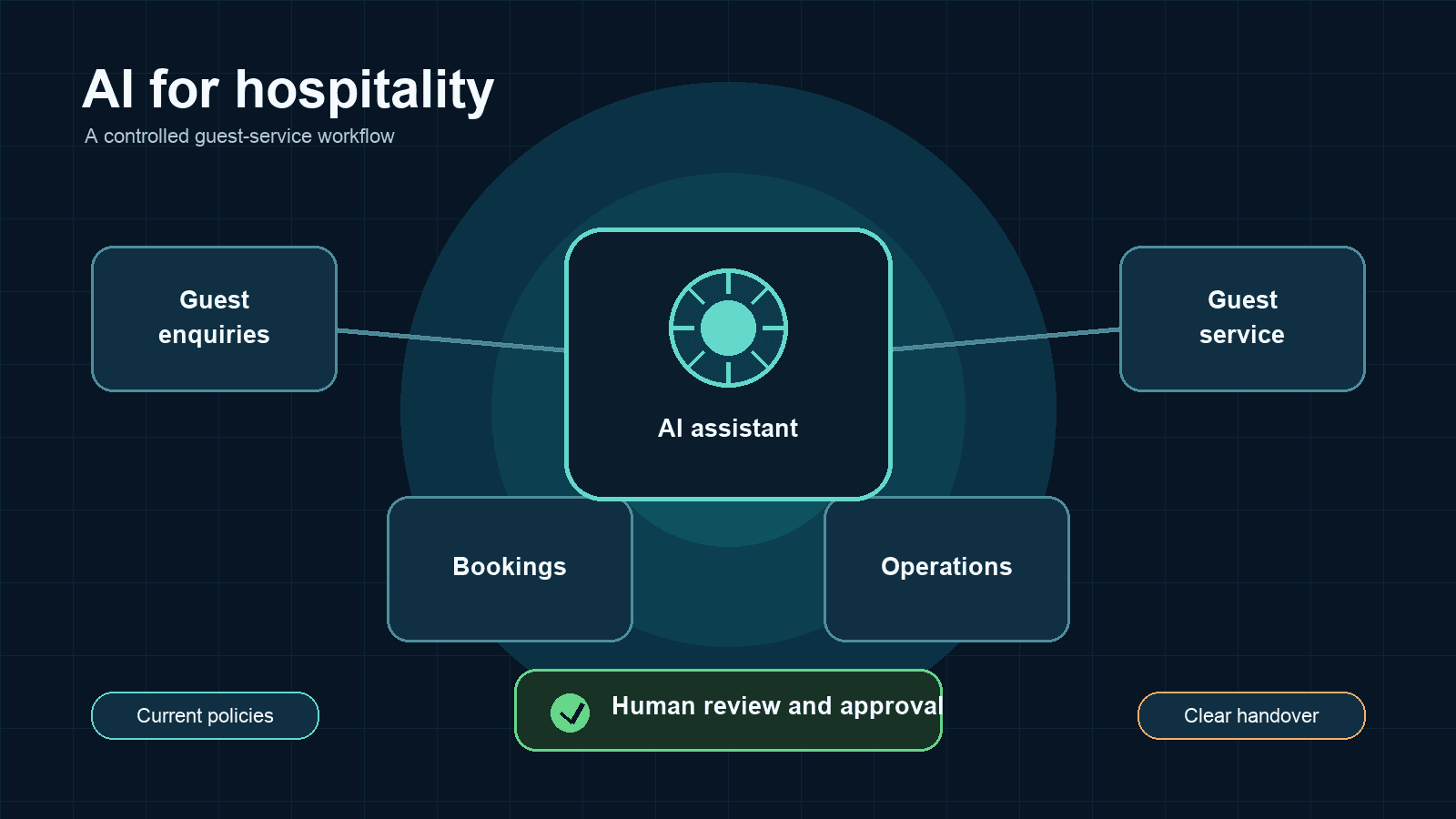
AI for hospitality is most useful when it helps staff answer routine enquiries, prepare booking work, summarise feedback and reduce repeated administration. Australian hotels, venues and accommodation operators should start with one measurable workflow, connect only the information it needs and keep people responsible for guest commitments, safety and service recovery.
A good first project supports the team rather than trying to replace hospitality. It gives staff a useful draft or review list, with the booking record, policy or source message beside it.
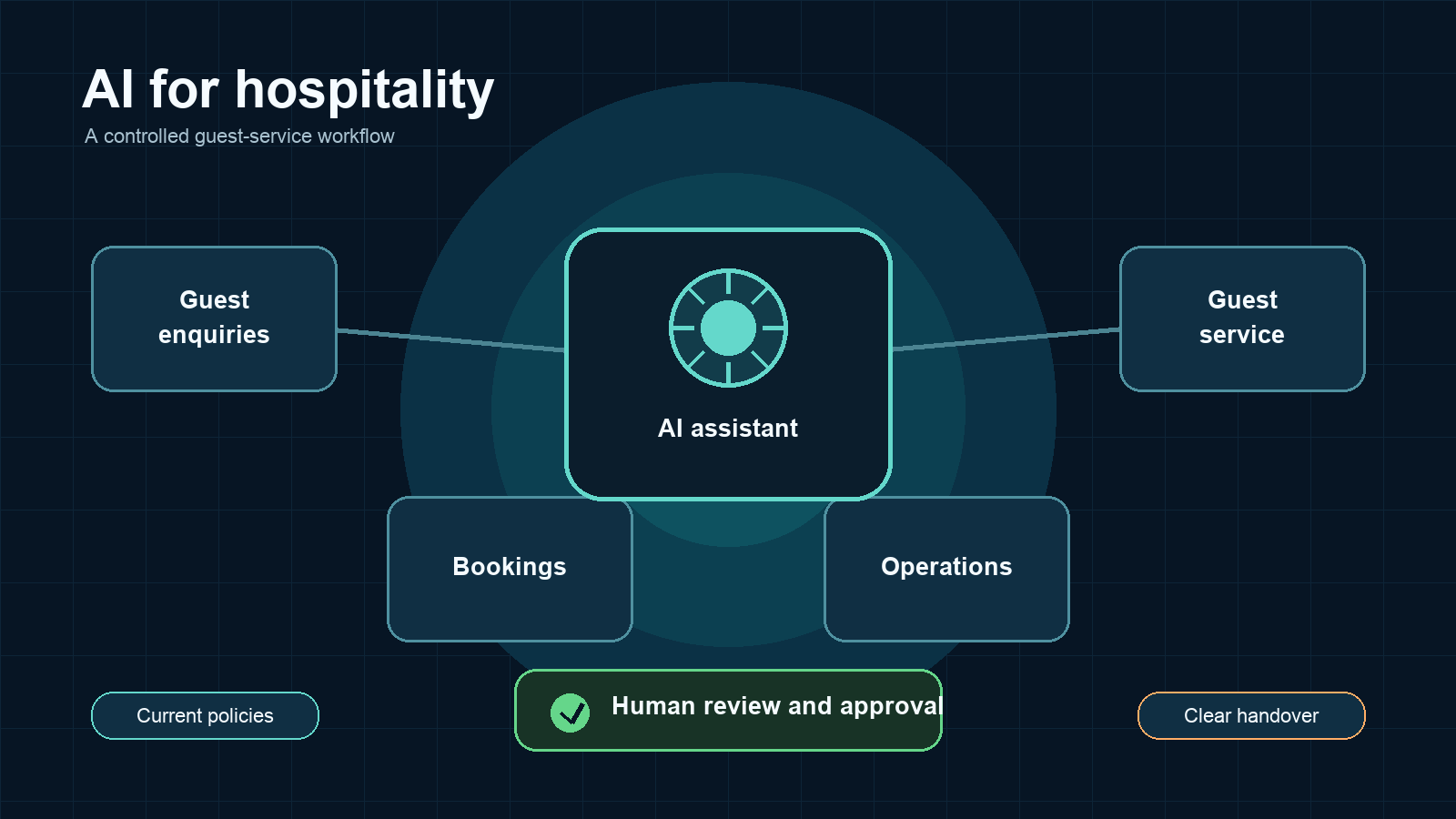
Key takeaways:
- Start with one repeated information task, such as guest-enquiry triage or daily operations reporting.
- Keep rates, availability, property policies and guest records in approved source systems.
- Require staff approval before changing bookings, issuing refunds or making guest commitments.
- Tell guests when they are dealing with an automated assistant and provide a clear handover to a person.
- Measure corrections, escalations and service outcomes as well as response time.
Contents
- How is AI used in hospitality?
- Which hospitality workflow should you automate first?
- Can AI handle guest enquiries and bookings?
- How can AI help hotel and venue operations?
- Can AI improve hospitality marketing and feedback analysis?
- What are the main risks of AI in hospitality?
- How should hospitality businesses protect guest data?
- How do you run a controlled hospitality AI pilot?
- How do you measure whether the project works?
- Frequently asked questions
How is AI used in hospitality?
AI is used in hospitality to classify guest messages, retrieve approved information, prepare replies, summarise shift activity, forecast demand and identify operational exceptions. The strongest uses have current source data, a narrow task and a staff member who remains responsible for the result.
Practical applications include:
- sorting guest enquiries by topic and urgency
- drafting replies from approved property information
- identifying booking messages that need staff action
- summarising arrivals, departures and unresolved requests
- grouping review comments and service issues
- forecasting short-term occupancy, demand or staffing needs
- checking invoices and supplier documents for missing fields
- searching current procedures, menus, packages and policies
- preparing event or group-booking follow-up tasks
These jobs need different systems. A language model can classify messages and prepare drafts. A forecasting model can estimate demand from historical patterns. An ordinary software rule may send a check-in reminder at a fixed time. Calling every function “AI” makes it harder to choose the simplest option and test it properly.
The Australian Bureau of Statistics reported that 12% of Australian businesses used AI in 2024–25, up from 1% in 2021–22. The survey measured use, not depth or value. A hospitality operator still needs evidence from its own bookings, service standards and workload before investing further.
Which hospitality workflow should you automate first?
For most hospitality businesses, the best first AI workflow is guest-enquiry triage. The system can classify incoming messages, retrieve relevant approved information and prepare a draft for staff review. It should escalate unclear, sensitive or high-value requests instead of inventing an answer.
| Workflow | Useful AI contribution | Human responsibility |
|---|---|---|
| Guest enquiries | Classify messages and draft replies from approved information | Confirm the answer and handle exceptions |
| Booking administration | Extract dates, names and requests from messages | Check availability, rates and booking changes |
| Daily operations | Summarise arrivals, departures, requests and unresolved tasks | Set priorities and assign work |
| Review analysis | Group recurring themes and identify examples for investigation | Confirm causes and decide service changes |
| Group or event leads | Extract requirements and prepare follow-up tasks | Scope, price and approve the proposal |
| Supplier documents | Extract fields and flag missing or conflicting information | Resolve discrepancies and approve records |
Choose a workflow with enough volume to measure and an error that staff can catch before it affects a guest. Define what the system may read, draft and recommend. Also define what it must never change.
A standard booking-platform feature is better when it already solves the job. Automated confirmations, payment reminders and scheduled pre-arrival messages do not need generative AI if the trigger and wording are fixed. AI becomes more useful when messages vary, information sits across approved sources or staff must review a large queue of exceptions.
Map the trigger, inputs, output, approval point and failure path before selecting software. Our guide to AI workflow automation gives a practical structure for this work.
Can AI handle guest enquiries and bookings?
AI can handle the first pass of routine guest enquiries when it works from current, approved information. It can identify the topic, find the relevant policy and prepare a response. Staff should remain responsible for booking changes, payment issues, complaints and promises that affect a guest’s stay.
A controlled enquiry workflow can:
- receive a message from an approved channel
- identify the property, booking and guest where possible
- classify the request and its urgency
- retrieve the relevant policy or booking record
- prepare a draft with the source information attached
- escalate when information is missing or conflicting
- let staff approve or edit the response
- record the decision and correction
Set clear handover rules. A guest should reach a person for accessibility needs, safety concerns, complaints, cancellations, refunds, payment disputes, lost property with sensitive contents and unusual booking requests. The system should not keep a guest trapped in a loop when it cannot resolve the issue.
Booking information changes quickly. Rates, room or table availability, package inclusions and cancellation terms should come from the system of record at the time of the request. Do not let a language model rely on an old website copy or a previous conversation when the current booking platform has the answer.
Generated replies also need boundaries. The system should not promise an upgrade, late checkout, special room, dietary accommodation or refund unless an authorised record confirms it. If the source does not support an answer, the correct output is to ask staff.
How can AI help hotel and venue operations?
AI can help hotel and venue teams prepare shift handovers, organise requests and identify work that may otherwise be missed. It should make operational information easier to review, not decide safety, maintenance or staffing matters without the right person.
A daily operations summary might combine approved records for:
- arrivals, departures and room or event status
- unresolved guest requests and promised follow-ups
- housekeeping or maintenance exceptions
- group, function and venue requirements
- stock or supplier issues
- incidents requiring manager review
- tasks that have passed an agreed response time
Each item should link to its source. A summary that says “three urgent maintenance issues” is not useful unless the manager can see the location, report time, status and original note.
For housekeeping, AI can help group requests, prepare room-status exception lists or summarise recurring maintenance notes. It should not mark a room ready, alter cleaning standards or decide whether a safety issue is resolved. Those actions need the approved operational process and accountable staff.
For rostering, forecasting can estimate likely labour needs from occupancy, covers, events and historical patterns. Managers still need to account for skills, availability, awards, fatigue, training and local conditions. Compare the forecast with a simple baseline before adding complexity.
A venue with weddings, conferences or group stays can also use AI to extract requirements from emails and prepare a checklist. Pricing, capacity, contractual terms and final commitments remain staff decisions.
Can AI improve hospitality marketing and feedback analysis?
AI can help hospitality teams organise guest feedback, prepare content drafts and identify repeated questions. It is less reliable as an unsupervised brand voice or a substitute for checking what happened.
Review analysis can group comments by themes such as check-in, cleanliness, noise, food, service and value. It can show representative examples and changes over time. A manager should still read the underlying reviews before changing a process or responding publicly. Sarcasm, mixed feedback and property-specific context can be misclassified.
For marketing, AI can draft a first version of an email, package description or social post from approved facts. Check every rate, date, inclusion, restriction and image before publication. Do not generate a view, facility or guest experience the property does not offer.
Keep consent and channel rules separate from content generation. An AI-written message does not create permission to contact someone. Use the business’s approved customer lists, preferences and unsubscribe process.
Personalisation should have a defined purpose. Remembering an approved room preference can improve service. Inferring sensitive personal traits from messages, images or behaviour creates risk without necessarily helping the guest. Collect and use only the information the workflow genuinely needs.
What are the main risks of AI in hospitality?
The main risks are incorrect guest commitments, poor handover, privacy failures, hidden bias and automation that removes the human judgement hospitality depends on. Risk rises when a system can change bookings, charge guests, issue refunds or send messages without review.
Out-of-date or invented information
A generated answer can sound confident while using an old policy or making up an inclusion. Require retrieval from approved sources, show those sources to staff and stop when current information is unavailable.
Failed escalation
A fast automated reply is harmful if it delays action on a safety concern, accessibility request or serious complaint. Define urgent categories, test varied wording and provide a direct route to staff.
Lost context between channels
A guest may call after sending an email or speak to reception after using chat. If staff cannot see the earlier interaction, the guest must repeat the issue and commitments may conflict. Record approved summaries in the relevant guest or booking system rather than leaving them inside a separate AI tool.
Over-automation of service
Hospitality depends on judgement, empathy and local knowledge. Keep people available for complex requests and service recovery. Use AI to prepare information, not to make every interaction uniform.
Unfair or intrusive personalisation
Recommendations based on incomplete profiles can treat guests inconsistently. Do not infer protected or sensitive characteristics. Review how the system segments, prioritises or prices requests, and give staff a way to question its output.
Australian Government guidance for AI adoption recommends six foundations, including accountability, impact assessment, risk management, disclosure, testing and meaningful human control. Apply them according to the consequence of each hospitality task.
How should hospitality businesses protect guest data?
Hospitality systems may contain names, contact details, travel dates, payment references, identification records, access information, preferences and messages about personal circumstances. Give an AI workflow only the access required for its defined task.
Before deployment, document:
- the systems, folders and fields the workflow can read
- which records it can create or change
- where prompts, files, outputs and logs are stored
- whether a provider can use business data to train models
- who can change instructions, integrations and permissions
- which actions require staff approval
- how unusual access and failed actions are logged
- how the workflow can be paused and removed
Use business accounts, role-based access and multifactor authentication. Separate testing from live guest records. Remove payment details, identification documents and sensitive notes when the task does not require them.
The Australian Signals Directorate’s guidance on deploying AI systems securely says controls should match the use case and threat profile. It recommends clear governance, secure configuration, access control, monitoring and maintenance. These controls should extend the hospitality business’s existing security process.
Review connected vendors as well as the AI provider. Booking, property management, point-of-sale, messaging and rostering systems may each hold different permissions and retention settings. A narrow AI workflow should not become a broad route into every system.
How do you run a controlled hospitality AI pilot?
Run a pilot on one workflow, with one accountable owner and a fixed review date. Keep the existing process available until the new workflow meets its agreed service, accuracy and privacy limits.
- Define the service problem. Record the trigger, inputs, current output, owner and consequence of an error.
- Measure the baseline. Capture weekly volume, response time, handling time, corrections and escalations.
- Set the boundary. State what the system may read, draft, recommend and never do.
- Prepare approved sources. Remove old policies, conflicting documents and unnecessary guest fields.
- Build test cases. Include routine questions, ambiguity, urgent issues, unusual bookings and missing information.
- Start read-only. Compare its classifications and drafts with real staff decisions.
- Require review. Show the source and record whether staff accepted, changed or rejected the result.
- Decide from evidence. Expand, revise or stop based on quality, risk and total effort.
Test the handover path as carefully as the routine answer. Use examples with misspellings, indirect language and messages containing several requests. Confirm that staff can see the original message, relevant record and draft together.
Run the pilot across realistic trading conditions. A system tested only on quiet weekday enquiries may perform differently during a sold-out weekend, a weather disruption or a major event.
If the workflow crosses email, bookings, property management and internal tasks, managed implementation may be more suitable than another standalone interface. Deployed AI’s managed AI services connect selected workflows to approved business tools, with setup, team training and ongoing Australian support.
How do you measure whether the project works?
Measure the complete guest and staff workflow. A reply generated in seconds can still add work if staff must search several systems to verify it.
Useful measures include:
- median first-response and resolution time
- percentage of drafts accepted without material correction
- urgent or sensitive enquiries escalated correctly
- relevant enquiries missed or escalated unnecessarily
- booking changes or commitments corrected before sending
- guest requests completed within the promised time
- staff review and maintenance time
- complaints linked to incorrect or impersonal responses
- privacy or security incidents
- total software, integration and support cost
For enquiry triage, review a defined sample each week and calculate accuracy by category. Treat a missed safety issue differently from a harmless misclassification. For daily summaries, count useful exceptions found, duplicate alerts and tasks omitted from the source records.
Compare performance by property, channel and request type where the sample is large enough. One overall score can hide weak results in after-hours messages or group bookings.
Agree on an expansion threshold before the pilot starts. The system might need to escalate every defined urgent test case, keep material errors below an agreed rate and reduce median handling time without increasing guest complaints. Set the threshold from the actual workflow and its consequences.
When is AI the wrong choice for a hospitality business?
AI is the wrong starting point when property information is out of date, booking processes vary by staff member or nobody owns guest handover. It is also unnecessary when an existing booking, property management or point-of-sale feature handles the task reliably.
Delay deployment if the business cannot test representative messages, explain where guest data goes or continue service when the AI is unavailable. Better procedures, templates, training or system configuration may deliver more value first.
The best option is the simplest one that meets the service requirement. AI should earn its extra cost and risk through measured performance in the real operation.
Where should an Australian hospitality business start?
Start with one week of routine guest enquiries. Count them by type, record the information staff retrieve and note which messages need a manager. Pick one repeated category where a person can verify the draft before it affects a booking or guest promise.
Test historical examples first, then run the system beside the existing process. Expand only when the evidence shows faster, more consistent work without weakening service, privacy or staff control.
For help selecting and testing a suitable workflow, book a free 30-minute AI audit.
Frequently asked questions
What is AI for hospitality?
AI for hospitality is software that classifies information, identifies patterns, forecasts demand or prepares actions for hotels, venues and accommodation operators. It can assist guest service and operations, while staff remain responsible for bookings, safety, payments and consequential decisions.
What is the best first AI project for a hospitality business?
Guest-enquiry triage is often the best first project because the input, source information and reviewer are clear. The system can sort messages and prepare drafts, while staff confirm answers and handle sensitive or unusual requests.
Can AI manage hotel bookings?
AI can extract booking details, answer routine questions and prepare changes for staff review. Availability, rates, cancellation terms, payments and final changes should come from the current booking system and remain subject to authorised controls.
Will AI replace hospitality staff?
AI is better suited to repeated information work than the judgement and care required in hospitality. It can reduce administration and help staff find the right information, but people should handle complex requests, service recovery and guest commitments.
How much does hospitality AI cost?
Cost depends on the workflow, booking and property-system connections, message volume, testing, user numbers and ongoing support. Compare the full cost with measured handling time, correction rates, service outcomes and staff effort from a narrow pilot before expanding.