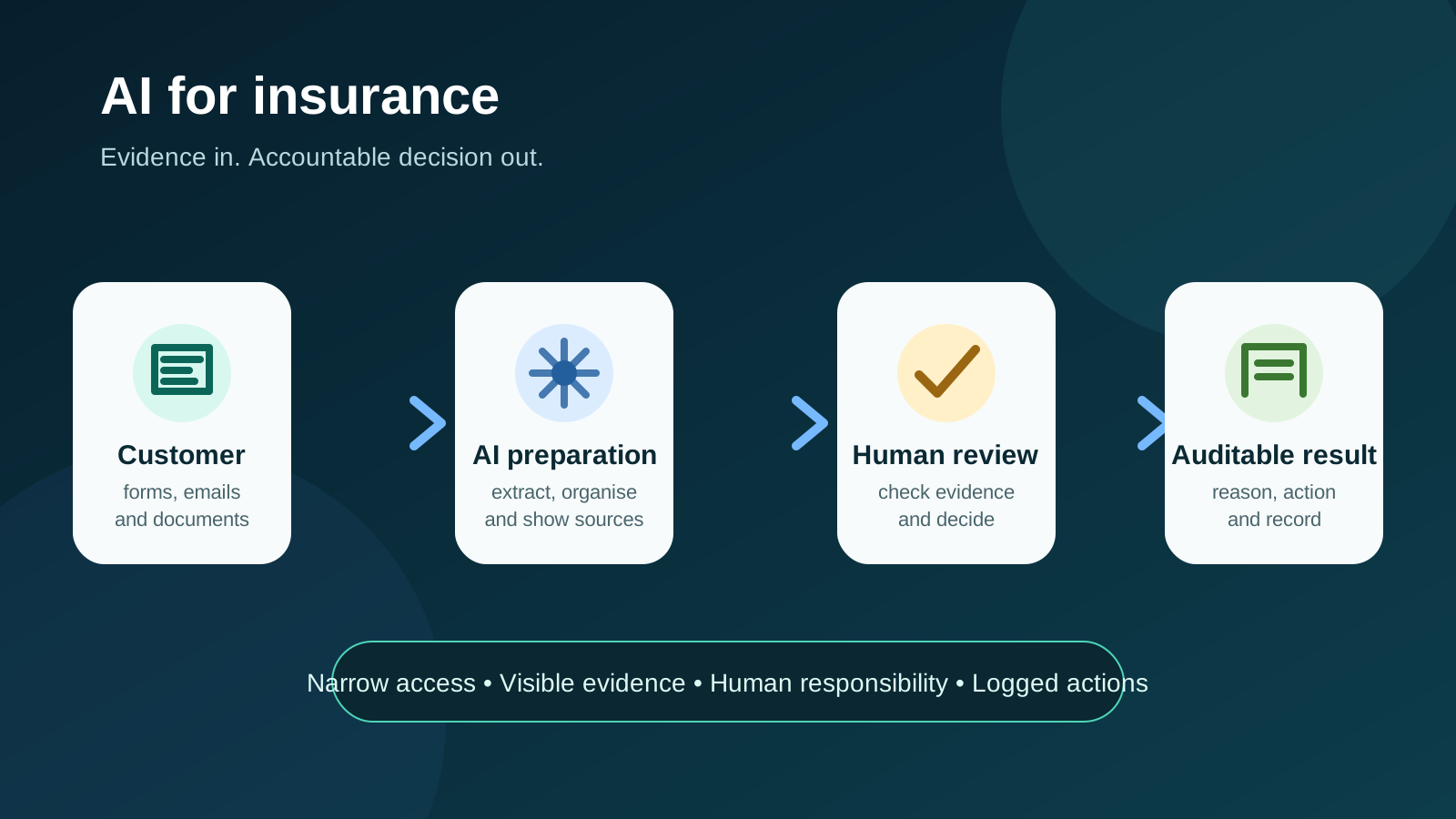
AI for insurance is most useful when it helps staff collect information, find policy evidence, prepare correspondence and identify work that needs attention. Australian insurers, brokers and claims teams can use AI to reduce repetitive handling without handing final coverage, liability or settlement decisions to a system.
The safest first project is a narrow, measurable workflow with approved sources, limited access and a person responsible for the outcome. Claims intake, document classification and service triage are usually better starting points than automated claim denial or pricing.
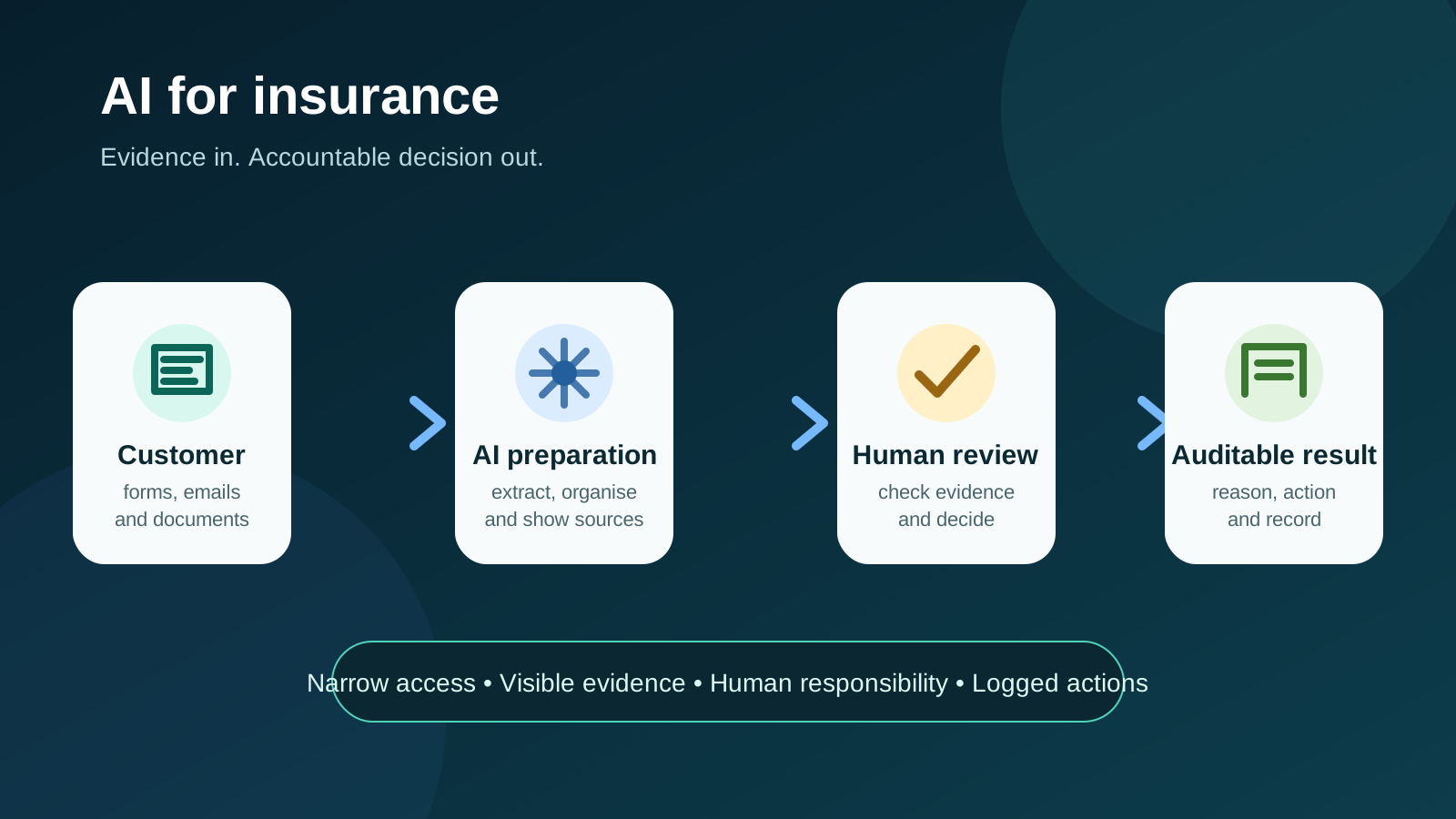
Key takeaways:
- Start with claims intake, document preparation or customer enquiry triage.
- Keep people responsible for coverage, liability, hardship, fraud and settlement decisions.
- Give the system only the data and permissions required for one workflow.
- Show staff the source behind summaries, recommendations and drafted answers.
- Measure accuracy, correction time, complaints and customer outcomes, not automation volume alone.
Contents
- How is AI used in insurance?
- Which insurance workflows should you automate first?
- How can AI help with insurance claims?
- Can brokers and underwriting teams use AI?
- What are the main risks of AI in insurance?
- How should insurance businesses protect customer data?
- How do you choose an insurance AI system?
- How do you run a controlled insurance AI pilot?
- Frequently asked questions
How is AI used in insurance?
AI can classify, extract, compare, summarise, draft and search across insurance work. It performs best when the task is repeated, the source evidence is available and a staff member can identify a wrong result before it affects a customer.
Practical uses include:
- extracting names, dates, insured items and incident details from submitted documents
- checking whether a claim file is missing required information
- classifying emails and routing them to the correct claims or policy team
- summarising a claim history with links to the underlying notes and documents
- drafting requests for information from approved templates
- comparing policy wording with a question raised by a customer or staff member
- preparing broker renewal packs and client review notes
- flagging unusual file activity or service delays for investigation
- searching procedures, product documents and approved guidance in plain language
The Australian Securities and Investments Commission reviewed 23 Australian financial services licensees and identified 624 AI use cases already in operation or planned. Its review found that most use cases augmented human decisions or improved efficiency, while some affected consumers directly.
That distinction matters. An internal tool that finds a relevant procedure creates a different risk from a model that influences a premium, claim outcome or fraud referral. Controls should match the consequence of the action.
Which insurance workflows should you automate first?
Start with a workflow that is frequent, document-heavy and easy to check. Claims intake, document classification and correspondence preparation usually create useful gains without giving the system authority over the final customer outcome.
| Workflow | Useful AI contribution | Human responsibility |
|---|---|---|
| Claims intake | Extract incident details, identify missing information and prepare a file summary | Confirm facts, urgency and the next action |
| Document handling | Classify forms, invoices, reports, photos and correspondence | Resolve uncertain or conflicting classifications |
| Customer enquiries | Retrieve approved information and draft a response | Check accuracy, tone and any commitment made |
| Broker renewals | Prepare exposure summaries, outstanding questions and comparison tables | Give advice, assess suitability and confirm recommendations |
| Claims correspondence | Draft acknowledgements and information requests from templates | Approve the wording and ensure it suits the customer’s circumstances |
| Operational monitoring | Flag delays, repeated rework or unusual file activity | Investigate the cause and decide what action is required |
Choose one process and record its baseline before changing it. Useful measures include handling time, backlog, rework, corrections, hand-offs, overdue files, complaints and customer response time.
Avoid starting with automated claim denial, fraud accusation, policy cancellation or settlement authority. These actions can cause financial and personal harm before an error is found. They also require context that may not be captured cleanly in the available data.
Our guide to AI workflow automation explains how to define triggers, approvals and exceptions before connecting systems.
How can AI help with insurance claims?
AI can help claims teams organise evidence and prepare work, but the claim decision should remain accountable to a person. A useful claims assistant makes the file easier to understand. It does not conceal how an outcome was reached.
A controlled claims workflow can:
- receive a form, email or uploaded document
- extract proposed facts and label each source
- identify missing or inconsistent information
- prepare a chronology and task list for staff
- draft routine correspondence from approved wording
- route urgent, vulnerable or complex matters to the right team
- log the source, model output, staff decision and final action
Source visibility is essential. If a summary says the customer reported water damage on a particular date, the reviewer should be able to open the exact email, form or call note supporting that statement. Unsupported details should be marked as uncertain rather than completed by inference.
Claims handling and settling is regulated as a financial service. ASIC’s claims handling guidance explains the obligations that apply to insurers and other relevant parties. Adding AI does not remove those obligations or transfer accountability to a software provider.
Set explicit escalation rules for injury, financial hardship, family violence, potential vulnerability, complaints, suspected fraud, legal correspondence and disputed facts. Speed is useful only when the workflow also protects fair treatment and review.
Can brokers and underwriting teams use AI?
Insurance brokers can use AI to prepare client files, compare documents and reduce repetitive follow-up. Underwriting teams can use it to organise submissions, identify missing information and surface factors for an authorised person to assess.
Useful broker workflows include:
- extracting renewal information from schedules and proposal forms
- comparing the current file with the previous period
- drafting a list of unanswered questions for the client
- preparing meeting notes and action items
- finding relevant product documents and approved explanations
- checking whether standard file records are present
Useful underwriting support includes document intake, submission triage, evidence retrieval and exception flags. The system can prepare information for consideration, while the authorised person remains responsible for judgement and the reasons behind the decision.
Be cautious when a model influences price, acceptance, exclusions or coverage. Historical insurance data may contain incomplete records, proxy variables or patterns that produce unfair outcomes. Test results across relevant customer groups, record which factors are used and provide a clear review path.
For many businesses, the best first deployment is not predictive underwriting. It is faster preparation of an accurate file using information the team already has authority to use.
What are the main risks of AI in insurance?
The main risks are inaccurate summaries, unfair decisions, weak explanations, privacy breaches, excessive access and automation that acts before staff can review it.
Incorrect or incomplete information
Generative AI can produce a fluent summary that changes a date, omits a qualification or joins facts that came from different people. Require links to source evidence, test difficult files and treat missing information as missing.
Unfair customer outcomes
A model can reproduce patterns in historical decisions even when those patterns are not appropriate for future customers. Test for adverse outcomes, review proxy variables and keep consequential decisions contestable.
Poor explanations
Staff must be able to understand why a matter was flagged and which evidence informed the result. A score without useful reasons is a weak basis for action, especially where the customer may need an explanation or review.
Excessive permissions
A tool that prepares a summary does not need authority to alter coverage, approve a payment or export an entire customer database. Apply minimum access, separate preparation from approval and log consequential actions.
Operational dependence
A workflow can fail because an integration changes, a document format shifts or the model behaves differently after an update. Keep a fallback process, monitor failures and re-test after material changes.
ASIC has warned that AI adoption can outpace governance, creating governance gaps and risks of consumer harm. Assign an owner to each workflow, maintain an inventory of approved uses and give staff a simple way to report an incorrect or concerning result.
How should insurance businesses protect customer data?
Insurance files can contain identity documents, financial information, health details, property records, recordings and information about distressing events. Start with a data map, not a product demonstration.
The Office of the Australian Information Commissioner says privacy obligations apply to personal information entered into an AI system and to generated output containing personal information. Its guidance on commercially available AI products recommends due diligence, human oversight, transparency and privacy by design. It also recommends, as a matter of best practice, not entering personal or sensitive information into publicly available generative AI tools.
Before connecting insurance data, confirm:
- the specific purpose of the workflow
- the minimum fields and documents it requires
- where data is processed and retained
- whether prompts, files or outputs are used for model training
- which provider staff and connected services can access information
- how customer consent, notice and existing collection purposes apply
- how access, correction, deletion and incident requests are handled
- whether logs contain additional personal or sensitive information
- how the business can export records and stop the service
Use business accounts, role-based access and multifactor authentication. Separate development and test data from live customer records. Remove or mask personal information when it is not required for the task.
For APRA-regulated organisations, technology arrangements also sit within wider operational risk responsibilities. CPS 230 Operational Risk Management covers operational risk, service provider management and business continuity. AI systems should be included in the same inventory, accountability and continuity processes as other material technology services.
An AI audit for business can help identify unapproved tools, map information flows and prioritise controls before deployment.
How do you choose an insurance AI system?
Choose the workflow first, then assess products against the evidence, permissions, actions and review process it requires. A polished demonstration is not proof that a tool can handle real policy wording, incomplete files and customer exceptions.
Ask vendors to show:
| Question | What a useful answer includes |
|---|---|
| What information does the system use? | Exact inputs, approved sources, retention and model-training settings |
| How does it handle missing evidence? | Clear uncertainty, no invented facts and escalation to staff |
| Can reviewers see the source? | Links to the document, message or record behind each material statement |
| What actions can it take? | Narrow permissions, approval gates, logs and rollback arrangements |
| How is access controlled? | Business accounts, roles, multifactor authentication and offboarding |
| How is quality tested? | Your own file types, policy wording, difficult cases and acceptance thresholds |
| How are model changes managed? | Version records, regression testing and notification of material changes |
| What happens during an outage? | Alerts, fallback procedures, support arrangements and export access |
Test with actual operating conditions. Include scanned documents, handwriting, contradictory dates, multiple insured parties, incomplete forms, vulnerable customers, complaints and requests the system should refuse.
Calculate the total cost, including integration, staff review, correction, monitoring, security, recordkeeping and ongoing maintenance. A low subscription price can still be poor value if employees must reconstruct every source or manually repair files.
How do you run a controlled insurance AI pilot?
Run the pilot on one workflow, within one team, for a defined period. Keep the existing process available until the new workflow meets agreed quality and reliability thresholds.
A practical pilot has seven stages:
- Define the task. Document the trigger, inputs, output, owner and prohibited actions.
- Record the baseline. Measure current volume, handling time, rework, complaints and overdue work.
- Prepare approved sources. Confirm policy documents, templates, procedures and access rights.
- Limit access. Connect only the required systems and begin in draft or read-only mode.
- Build test cases. Include routine files, missing evidence, conflicts, vulnerability and high-consequence exceptions.
- Require review. Show sources and record the staff decision while the workflow proves itself.
- Decide from evidence. Expand, revise or stop based on quality, customer outcomes and total effort.
Useful measures include:
- extraction and classification accuracy
- percentage of summaries accepted without correction
- average handling and correction time
- missing information identified and missed
- escalation accuracy
- overdue work and customer response time
- complaints and adverse customer outcomes
- privacy, access or security incidents
- staff adoption of the approved workflow
Do not remove review merely because the system is fast. Reduce review only for low-consequence categories that consistently pass testing and remain easy to audit. Re-test whenever policy wording, procedures, integrations or model behaviour change.
What is the best first AI project for an insurance business?
For many Australian insurance businesses, the best first AI project is claims or service intake with a staff-reviewed file summary. It is frequent, measurable and can reduce document handling without giving the system authority over the final outcome.
Start with a small set of common file types. Require the system to show the source for each extracted fact, identify missing information and place uncertain files in a review queue. Measure correction time and missed details before expanding the scope.
For a brokerage with efficient claims intake, renewal preparation may be the stronger first project. AI can compare current and previous documents, prepare unanswered questions and organise the file while the broker retains responsibility for advice and recommendations.
Frequently asked questions
How is AI used in insurance?
Insurance businesses use AI to classify documents, extract claim information, summarise files, draft correspondence, route enquiries and flag work that needs attention. The safest uses prepare evidence for staff rather than make final coverage, liability or settlement decisions.
Can AI process insurance claims?
AI can help receive, organise and summarise a claim, identify missing information and prepare routine correspondence. A person should remain accountable for consequential decisions, difficult circumstances, disputed facts and the final customer outcome.
Can insurance brokers use AI?
Yes. Brokers can use AI to prepare renewal files, compare documents, draft follow-up questions, search approved product information and organise meeting notes. Advice, suitability assessment and final recommendations still require accountable professional judgement.
Is customer insurance data safe in an AI tool?
Only after the business has assessed the product, purpose, privacy obligations, security, retention, training settings and access controls. Personal or sensitive information should not be entered into public generative AI tools. Use the minimum information required for the approved workflow.
How do you measure insurance AI performance?
Compare the pilot with the existing process. Measure accuracy, correction time, missing information, escalations, overdue work, complaints, customer outcomes and total operating effort. Automation volume alone does not show whether the workflow is safe or useful.
Start with one accountable insurance workflow
AI can help Australian insurance teams organise evidence, prepare files and respond more consistently. The result depends on reliable sources, limited access, visible reasons and clear human responsibility.
Choose one repeated workflow, record its current performance and test difficult files before allowing broader actions. Deployed AI builds managed AI systems that connect with selected business tools, including setup, team training and ongoing Australian support. Book a free 30-minute AI audit to assess the first insurance workflow worth improving.