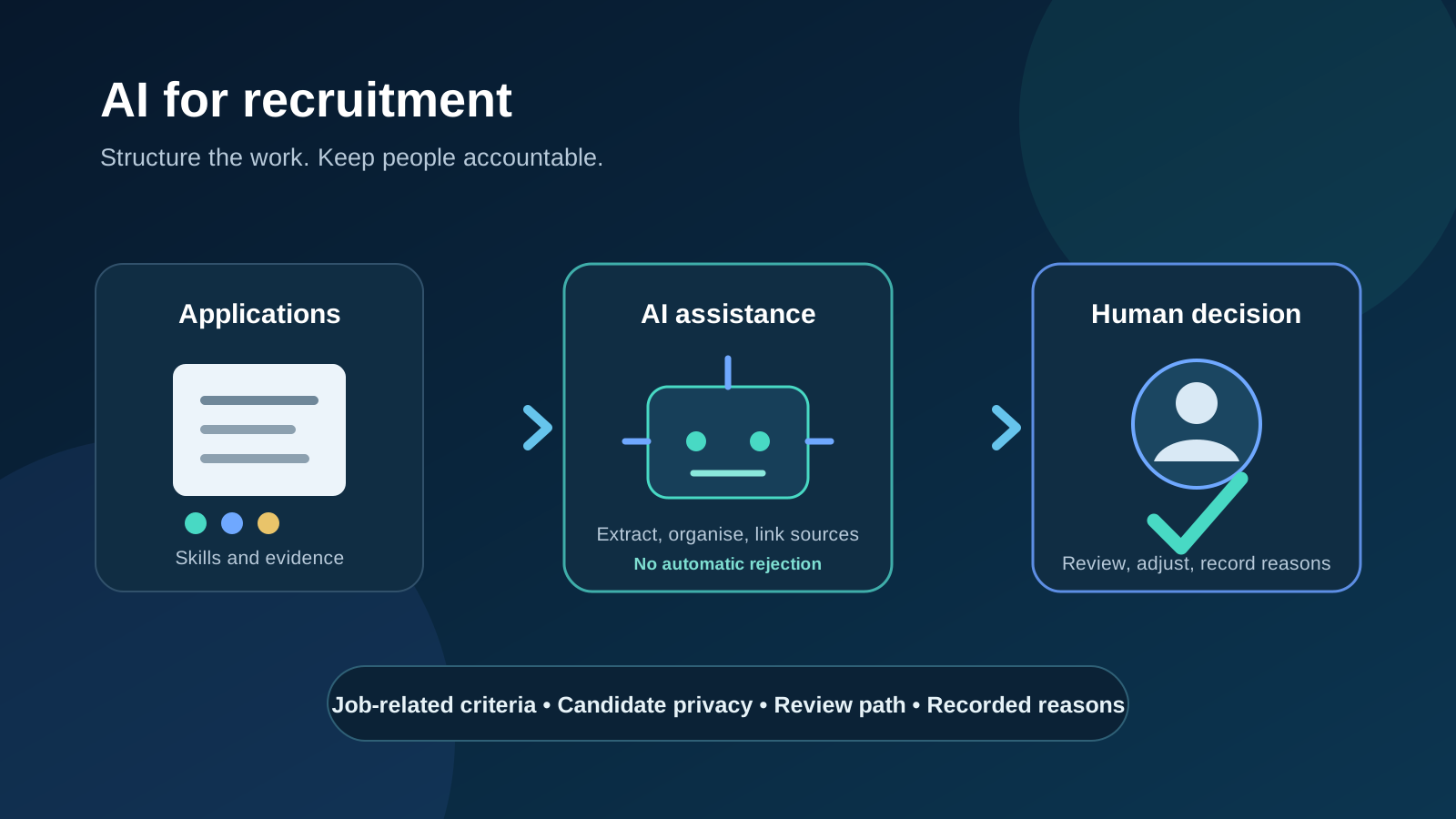
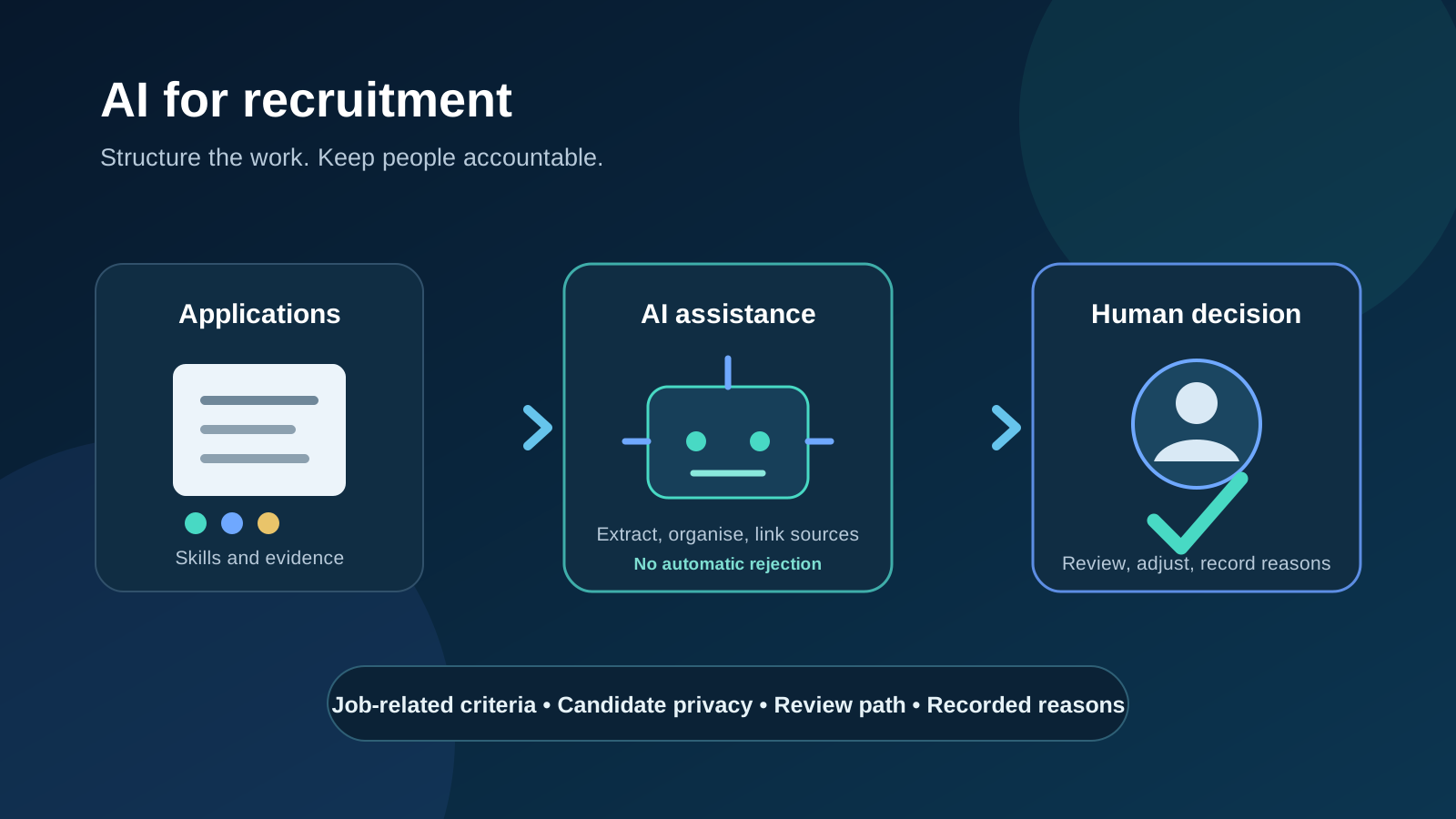
AI for recruitment can help Australian employers draft job advertisements, organise applications, schedule interviews and prepare consistent candidate summaries. It should support the hiring team, not make an unexplained decision about who gets a job. The employer remains responsible for privacy, fairness and the final outcome.
For most businesses, the best first use is low-consequence administration. Start with interview scheduling, candidate communications or staff-reviewed application summaries. Avoid automatic rejection until the business can prove the criteria are job-related, the results are accurate and candidates have a practical review path.
Key takeaways:
- Use AI to prepare information, while people retain hiring authority.
- Define job-related criteria before configuring screening or ranking.
- Tell candidates how AI is used and protect their personal information.
- Test outcomes across relevant candidate groups, not just average accuracy.
- Measure candidate experience, corrections and hiring quality alongside speed.
Contents
- How is AI used in recruitment?
- Which recruitment tasks should you automate first?
- Should AI screen or reject job applicants?
- How can AI bias affect recruitment?
- How should employers protect candidate privacy?
- What should you look for in AI recruitment software?
- How do candidates use AI in job applications?
- How do you run a controlled recruitment AI pilot?
- Frequently asked questions
How is AI used in recruitment?
AI is used in recruitment to write and check job advertisements, search candidate databases, extract information from applications, summarise experience, schedule interviews, draft communications and support assessment. Some products also score, rank or reject candidates.
These uses do not carry the same risk. A scheduling assistant can create inconvenience if it makes a mistake. A screening system can prevent a person from being considered for work before anyone reviews their application.
Common recruitment uses include:
- drafting a job advertisement from an approved position description
- checking an advertisement for unclear language or inconsistent requirements
- extracting qualifications, licences and work history into structured fields
- preparing candidate summaries with links to the original application
- finding applicants who meet clearly defined, job-related requirements
- drafting consistent emails about interviews, timelines and next steps
- coordinating calendars and interview availability
- preparing interview questions against agreed selection criteria
- transcribing panel notes with consent and access controls
- producing a comparison table for a human selection panel
The Merit Protection Commissioner reported that 15 of 66 Australian Public Service agencies surveyed in 2022 had used AI-assisted or automated recruitment tools. The guidance covers résumé scanners, AI-reviewed video interviews and automated psychometric testing. It also warns that tools vary in testing quality and may reproduce bias.
The practical dividing line is authority. AI can prepare, organise and flag information. A person should remain accountable for the criteria, evidence, exceptions and decision.
Which recruitment tasks should you automate first?
Start with tasks that are repeated, easy to check and unlikely to decide a candidate's future on their own. Interview scheduling, communication drafts and structured application summaries are usually safer starting points than ranking or rejection.
| Recruitment task | Useful AI contribution | Human responsibility |
|---|---|---|
| Job advertisement | Draft wording from an approved role description | Confirm duties, requirements, pay information and inclusive language |
| Application intake | Extract stated qualifications and experience | Check the source and resolve missing or conflicting information |
| Candidate communication | Draft acknowledgements, updates and interview details | Approve commitments, tone and individual adjustments |
| Interview scheduling | Match available times and send reminders | Handle accessibility needs, exceptions and errors |
| Interview preparation | Draft role-specific questions against set criteria | Check relevance, legality and consistency |
| Panel notes | Summarise recorded notes where consent and policy allow | Verify accuracy and retain the official record |
| Shortlisting support | Compare evidence against documented criteria | Review every recommendation and make the decision |
The best first workflow is often application intake. The system can extract facts stated by candidates, prepare a standard summary and link each item back to the résumé or cover letter. Recruiters spend less time reformatting information, while retaining direct access to the source.
Set one clear limit: absence of a keyword is not evidence that a candidate lacks a skill. Jobs and Skills Australia has warned that systems focused on job titles, qualifications and matching terms can miss transferable skills such as analysis, communication, teamwork and problem-solving. A structured review should help recruiters see evidence, not narrow the field to people who use the expected wording.
Our guide to AI workflow automation explains how to define triggers, approvals and exception paths before connecting a process to business systems.
Should AI screen or reject job applicants?
AI should not automatically reject applicants unless the employer can demonstrate that the criteria are necessary for the role, the tool assesses them reliably and a person can review exceptions. For most small and medium businesses, staff-reviewed shortlisting is the safer choice.
Hard screening can look efficient because it reduces the number of applications a recruiter sees. It can also hide qualified people when:
- a résumé uses different words for the same skill
- a career break changes the pattern the tool expects
- overseas experience or qualifications are formatted differently
- a disability affects a video, voice or timed assessment
- the job advertisement contains requirements that are not actually necessary
- the model infers qualities that the application does not establish
- historical hiring data reflects earlier bias or a narrow workforce
The Fair Work Ombudsman explains that prospective employees are protected from adverse action for discriminatory reasons. Protected attributes include age, race, sex, disability, pregnancy, religion and family or carer's responsibilities. Using software does not remove the employer's responsibility for a hiring process or its results.
If screening support is needed, use a staged approach:
- document the necessary requirements of the role
- separate mandatory checks from preferred experience
- configure the tool to show evidence, not just a score
- review candidates near the threshold and those with missing data
- test whether relevant groups receive different outcomes
- record who made the decision and why
- give candidates a way to request an adjustment or human review
Do not ask a model to infer personality, honesty, emotion or future performance from facial movement, voice, name, address or writing style. These signals may be unrelated to the work and difficult for a candidate to contest.
How can AI bias affect recruitment?
AI bias can affect recruitment when the data, labels, criteria or design favour some candidates for reasons unrelated to job performance. A consistent automated process is not necessarily a fair one. It can apply the same unsuitable rule to every applicant.
Bias can enter through several points:
Historical hiring data
A model trained to resemble previous successful hires may repeat the preferences that shaped those hires. If a business historically recruited from a narrow set of backgrounds, the system may treat that pattern as evidence of suitability.
Proxy information
Postcode, employment gaps, school names, word choice and career history can act as proxies for personal circumstances. Removing a protected attribute does not solve the problem if other fields still reveal or closely correlate with it.
Unclear job criteria
A tool cannot fix a poorly defined role. If the selection criteria mix necessary skills with habits, personality preferences or credentials that do not matter, automation can make the error faster and harder to see.
Incomplete applications
People describe equivalent experience in different ways. Keyword matching may overlook transferable skills, informal experience and applicants changing industries.
Automation bias
Recruiters may trust a score because it appears objective. The Merit Protection Commissioner's guidance warns against over-reliance on automated decisions and recommends keeping humans actively involved at different stages.
Test the whole process, not just the model. Compare who applies, who is screened in, who is interviewed and who is selected. Review correction rates and candidate complaints. Investigate meaningful differences before broadening the tool's authority.
A useful test set includes applicants with career breaks, varied résumé layouts, overseas experience, disability adjustments, different educational pathways and evidence of transferable skills. Use synthetic or properly authorised data during early testing rather than uploading real applications to an unapproved product.
How should employers protect candidate privacy?
Candidate applications contain personal information and may include sensitive details, identity documents, contact data, work history and referee information. Employers should map what the AI product receives, why it needs that information, where it goes and how long it is retained.
The Office of the Australian Information Commissioner says privacy obligations apply to personal information entered into an AI system and to AI output containing personal information. Its guidance recommends due diligence, privacy by design, human oversight and clear information about how AI is used. It also recommends not entering personal or sensitive information into publicly available generative AI tools as a matter of best practice.
Before using candidate data, answer these questions:
- What recruitment purpose does the tool serve?
- Which fields and documents are genuinely required?
- Is the use consistent with the notice given when information was collected?
- Where is the data processed, stored and backed up?
- Are prompts, files or outputs used to train models?
- Which provider staff and connected services can access the data?
- How are retention, deletion, correction and access requests handled?
- Can the business export records and stop using the service?
- Does the system create inferred information about candidates?
- Are decisions and human changes logged?
Use business accounts, role-based access and multifactor authentication. Keep recruitment data out of personal AI accounts. Give the system access only to the current hiring workflow, not an entire employee or customer database.
Tell candidates when AI materially affects collection, assessment or communication. Explain what the system does in plain language, name the information used and offer a contact for questions, adjustments or review. A generic statement that the business "uses technology" is not enough to help a candidate understand the process.
An AI audit for business can identify unapproved tools, personal information flows and access risks before a recruitment system is connected.
What should you look for in AI recruitment software?
Choose AI recruitment software by testing it against a real, documented hiring workflow. Do not start with a feature list. Start with the role criteria, candidate evidence, privacy needs, exceptions and decision points.
| Question for the provider | What a useful answer includes |
|---|---|
| What does the system assess? | Specific job-related criteria and the evidence used for each result |
| How was it validated? | Methods, relevant roles, Australian context and known limitations |
| How is bias tested? | Results across relevant groups, monitoring and a process for correcting issues |
| Can recruiters see the source? | Direct links to candidate evidence behind summaries or flags |
| Can a person override it? | Clear review controls, recorded reasons and no hidden automatic rejection |
| How is candidate data handled? | Processing locations, retention, training settings, subprocessors and deletion |
| What changes over time? | Model version records, release notices and regression testing |
| Can candidates be accommodated? | Alternative formats, adjustment paths and accessible assessments |
| What happens during an outage? | Export access, fallback steps, support and recovery arrangements |
Ask the provider to demonstrate the tool on difficult cases, not a polished sample. Test inconsistent dates, unusual résumé layouts, equivalent qualifications, employment gaps, missing information and a request for reasonable adjustment.
Check the total operating cost. Include implementation, integration, recruiter review, candidate support, security assessment, monitoring and correction. A product that produces quick rankings may cost more if staff cannot understand them or must resolve avoidable complaints.
For most Australian businesses, the best product is one that helps staff find and compare evidence without pretending to replace judgement. Source visibility and controlled permissions matter more than a confident score.
How do candidates use AI in job applications?
Candidates use AI to research roles, improve wording, check spelling, practise interviews and draft application material. Employers should set a clear policy that distinguishes reasonable support from misrepresentation or unauthorised help during an assessment.
The Australian Taxation Office provides a useful public example. Its candidate guidelines allow AI to support preparation but require applications to reflect the person's real skills and experience. The ATO also states that it may use AI to develop job advertisements and information kits, but human panels make selection decisions.
A practical employer policy should explain:
- whether candidates may use AI to edit or organise written material
- which interviews, tests or work samples must be completed without AI assistance
- when candidates should disclose AI use
- that invented experience or qualifications are unacceptable
- how personal or confidential information should be protected
- what happens if the rules are unclear or technology fails
Design assessments around evidence. Ask candidates to explain a decision, discuss a real example, complete a relevant task or respond to follow-up questions. Trying to detect AI-written text from style alone is unreliable and can distract from whether the applicant can do the work.
Apply the policy consistently and make adjustments available. A candidate may use assistive technology for disability access, so a broad ban on digital assistance can create unfair barriers.
How do you run a controlled recruitment AI pilot?
Run the pilot on one recruitment task, one team and a defined set of roles. Keep the existing process available until the new workflow meets agreed standards for accuracy, fairness, privacy and candidate experience.
A practical pilot has seven stages:
- Define the task. Record the input, output, owner, prohibited actions and decision boundary.
- Set the criteria. Confirm the requirements are job-related and distinguish mandatory from preferred.
- Protect the data. Complete privacy and security checks before using real candidate information.
- Build test cases. Include routine applications, missing information, varied formats and relevant candidate groups.
- Run in parallel. Compare AI-supported work with the existing process without automatic rejection.
- Review outcomes. Check accuracy, corrections, group differences, complaints and recruiter behaviour.
- Decide from evidence. Expand, revise or stop the workflow based on results and total effort.
Useful measures include:
- time spent on administration and correction
- extraction and summary accuracy
- percentage of outputs accepted without change
- qualified candidates missed or incorrectly flagged
- shortlist and progression rates across relevant groups
- candidate questions, adjustment requests and complaints
- time from application to meaningful response
- privacy, access or security incidents
- recruiter use of the approved process
- quality of hire using an agreed, job-related measure
Do not remove human review because the first few rounds appear accurate. Re-test after changes to the role, criteria, application form, integration or model. Monitor whether recruiters are using the tool as designed rather than relying on scores without checking evidence.
What is the best first AI recruitment project?
For most employers, the best first AI recruitment project is a staff-reviewed candidate summary. It reduces manual reformatting while keeping the original application visible and leaving the shortlist decision with the hiring team.
Configure the system to extract only agreed fields, mark missing information and link every statement back to its source. Do not let it invent a score from presentation style or infer personal qualities. Recruiters should correct the summary before it becomes part of the hiring record.
Interview scheduling is a lower-risk alternative for businesses with high coordination costs. It can propose times, issue reminders and handle routine rescheduling, while sending accessibility requests and unusual circumstances to a person.
Frequently asked questions
How is AI used in recruitment?
AI is used to draft job advertisements, organise applications, extract qualifications, schedule interviews, prepare candidate summaries and support structured comparison. Some tools also rank or reject candidates, which requires stronger testing, transparency and human review.
Can employers use AI to shortlist candidates in Australia?
Employers can use AI to support shortlisting, but they remain responsible for privacy, discrimination risks and the decision. Criteria should be necessary for the role, results should be tested across relevant groups and candidates should have access to adjustments and human review.
Is it safe to upload résumés to an AI tool?
Only after the employer has assessed the product's privacy, security, retention, access and model-training settings. Candidate information should not be placed in public generative AI tools. Use the minimum data required and tell candidates how their information is handled.
Can AI remove bias from recruitment?
No. AI can apply structured criteria consistently, but it can also reproduce bias in data, labels, criteria and product design. Employers need job-related requirements, diverse test cases, outcome monitoring and accountable human decisions.
Should candidates be allowed to use AI in applications?
Candidates can reasonably use AI for research, preparation and editing if the final application truthfully represents their own skills and experience. Employers should state which assessments prohibit AI assistance, how disclosure works and how accessibility tools are treated.
Build a fairer recruitment workflow before automating it
AI can reduce repetitive recruitment administration and help hiring teams review information consistently. It cannot decide what fairness means for a role or carry the employer's accountability.
Start with one task, make the source evidence visible and test the workflow with candidates who do not fit a standard résumé pattern. Deployed AI builds managed AI systems that connect with selected business tools, including setup, team training and ongoing Australian support. Book a free 30-minute AI audit to assess a recruitment workflow before giving it access to candidate data.