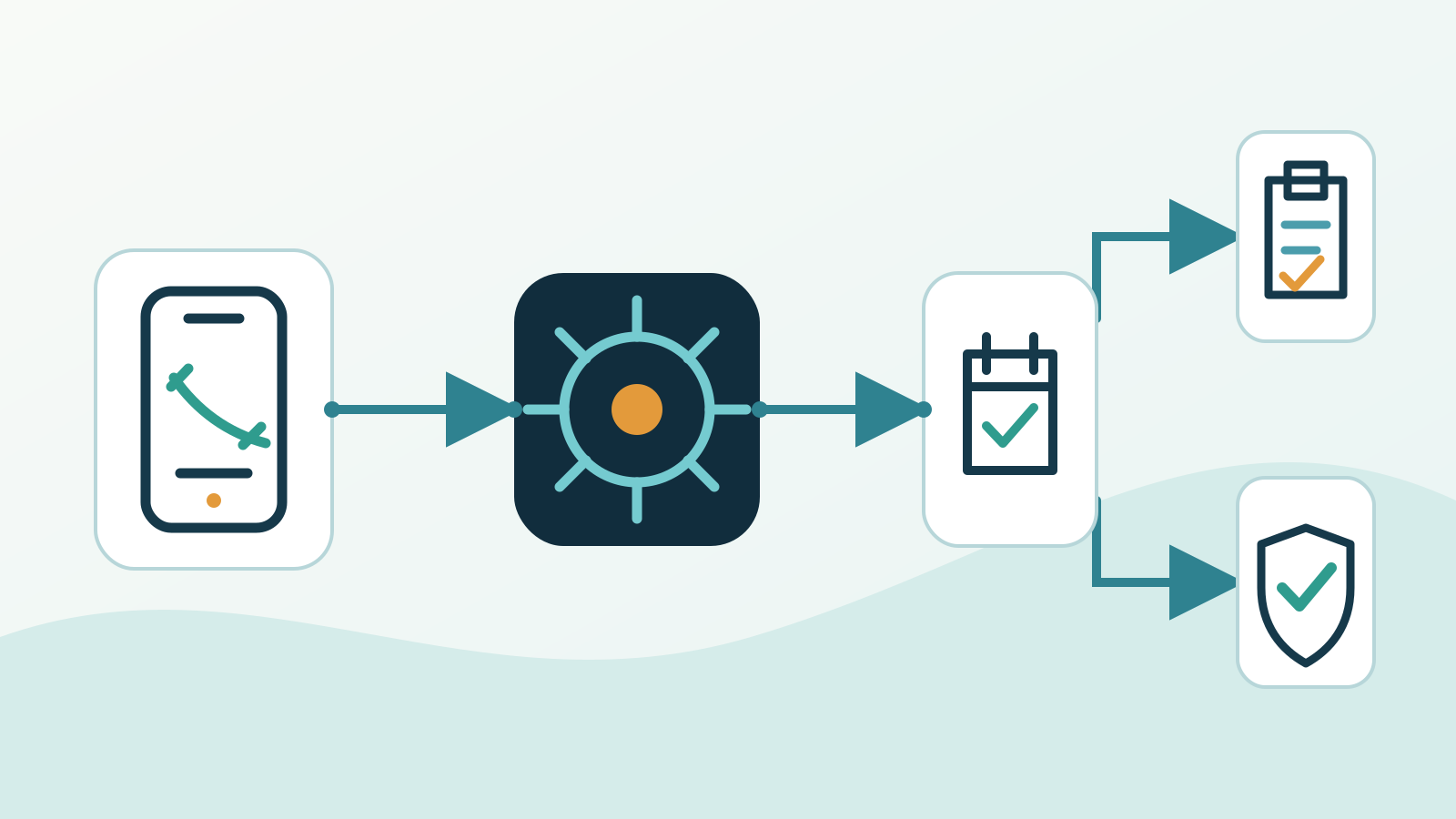
AI for tradies can help a trade business respond to enquiries, prepare quote drafts, organise schedules, turn site notes into job records and follow up unpaid invoices. The best setup handles repeated administration around the job while the tradie keeps control of pricing, technical decisions, customer promises and safety.
Start with one office task that already follows a clear process. Missed-call follow-up or turning completed job notes into an invoice draft is usually safer and easier to measure than letting AI quote, schedule and message customers on its own.
Key takeaways:
- Use AI for repeated office work around a job, not licensed trade work or safety decisions.
- Keep quotes, variations, arrival times, payment details and customer messages under human approval.
- Connect only the calendar, inbox, job system and documents needed for the chosen task.
- Test exceptions such as urgent call-outs, incomplete notes and jobs outside the service area.
- Measure response time, correction effort, missed work and cash collection before expanding.
Contents
- How can Australian tradies use AI?
- Which AI workflow should a trade business start with?
- Can AI answer calls and qualify enquiries?
- Can AI prepare quotes for trade work?
- How can AI help with scheduling and dispatch?
- Can AI turn site notes into job records and invoices?
- What privacy, security and consumer risks matter?
- How do you run a controlled AI pilot?
- How should a trade business measure the result?
- When is AI the wrong tool for a tradie?
- Frequently asked questions
How can Australian tradies use AI?
Australian tradies can use AI to collect information, classify requests, retrieve approved records and prepare drafts. Useful applications sit around the physical work: enquiry handling, scheduling, job administration, customer updates, document preparation and follow-up.
For example, a controlled system could:
- capture a missed call and draft a text asking for the address, job type and urgency
- summarise an enquiry into a job card for office review
- suggest available appointment windows from the real calendar
- prepare a quote draft from an approved price list and scope template
- turn a voice note into structured materials, labour and follow-up actions
- draft a completion message from confirmed job details
- flag invoices that meet the business's existing follow-up rules
The Australian Bureau of Statistics reported that 12% of Australian businesses used AI in 2024–25, up from 1% in 2021–22. The same survey found that 13% of businesses reported a shortage of trade skills. AI does not replace a qualified person, but it can reduce some administrative pressure around scarce trade time.
A standard form or rule may still be the better tool. Online booking already works for a fixed service with known duration and price. AI becomes useful when an enquiry arrives as a call, email, photo or free-text message that needs to be organised before a person decides what happens next.
Which AI workflow should a trade business start with?
For most trade businesses, the best first AI workflow is missed-enquiry follow-up. It has a clear trigger, a short response, measurable timing and a natural human handover before any quote or booking is confirmed.
| Workflow | Useful AI contribution | Human responsibility |
|---|---|---|
| Missed enquiry | Collect basic job details and draft a reply | Confirm urgency, fit and next step |
| Quote preparation | Assemble a draft from approved rates and scope | Inspect the job, price risk and approve terms |
| Scheduling | Suggest suitable windows from current records | Confirm duration, travel, skills and customer promise |
| Site notes | Structure voice notes, photos and actions | Confirm technical accuracy and completeness |
| Invoice preparation | Draft line items from approved job records | Check work, variations, tax and amount |
| Payment follow-up | Flag invoices and draft reminders | Resolve disputes and approve communication |
Choose a workflow that occurs often enough to test over two to four weeks. Write down its trigger, approved inputs, expected output, reviewer and prohibited actions. A vague goal such as "automate the office" is too broad to build or measure.
If missed calls are rare but technicians spend an hour each afternoon typing notes, start with job records instead. The right first task is the narrowest repeated bottleneck with reliable inputs and an accountable reviewer.
Our guide to AI workflow automation explains how to map the trigger, sources, approvals and actions before choosing software.
Can AI answer calls and qualify enquiries?
AI can answer a call or message, collect basic details and route the enquiry. It should identify itself clearly, avoid giving technical assurances and provide a simple way to reach a person.
A useful intake can collect:
- the customer's name and preferred contact method
- the job address or suburb
- a plain-language description of the issue
- whether there is immediate danger or property damage
- access constraints and preferred times
- photos or documents the customer chooses to provide
- consent to a follow-up call or message
Urgent and safety-related terms need a defined escalation. Electrical hazards, gas smells, flooding, fire, injury and other dangerous conditions should not be handled as ordinary booking requests. The system should give the business's approved safety wording and hand the matter to a person or emergency pathway.
Do not let an intake assistant promise a diagnosis, fixed price or arrival time unless the business has a genuinely fixed service and current availability. It can say that a team member will review the information and confirm the next step.
For a deeper comparison of call handling options, see our AI receptionist guide for Australian businesses.
Can AI prepare quotes for trade work?
AI can prepare a quote draft from confirmed scope notes, an approved price list and a current template. A qualified person still needs to assess the work, identify exclusions, price uncertainty and approve the final offer.
A controlled quote workflow should separate three types of information:
- Confirmed job facts: address, requested work, measurements, site observations and customer requirements.
- Approved business records: labour rates, materials, call-out fees, margins, terms and quote validity.
- Judgement: likely effort, access difficulty, compliance requirements, risk allowances and alternatives.
AI can organise the first two. The trade business owns the third. If the source notes conflict or required details are missing, the output should flag the gap rather than make an assumption.
The ACCC says claims about products and services must be accurate, truthful and based on reasonable grounds. This includes prices, descriptions, benefits and delivery times. A quote written with AI is still the business's communication.
Test drafts against real edge cases before use. Include hidden damage, provisional allowances, customer-supplied materials, after-hours work, restricted access and a requested service the business does not provide. Keep every first-stage quote in draft until an authorised person approves it.
How can AI help with scheduling and dispatch?
AI can suggest appointment windows by reading current jobs, staff availability, service areas and estimated durations. It should not silently move confirmed work or promise a time before the office checks travel, skills and dependencies.
Useful scheduling inputs include:
- the job type and likely duration
- technician qualifications and authorisations
- location and travel time
- parts or equipment required
- access windows and customer preferences
- existing confirmed work
- urgency and service-level rules
Keep hard constraints as rules. A licence requirement, unavailable part or blocked calendar should not be treated as a suggestion. AI can help explain why two jobs may fit together, but the scheduling system remains the source of truth.
Weather and previous jobs can also change the day. Build in a process for late-running work, cancellations and urgent call-outs. Customer updates should use confirmed information and avoid inventing an arrival estimate when the field team has not supplied one.
Can AI turn site notes into job records and invoices?
AI can turn a technician's voice note into a structured draft containing work completed, materials used, unresolved items, photos to attach and the next action. This can reduce double handling, provided the technician reviews the record while the job is still fresh.
Use a consistent note prompt. Ask the technician to state the job number, completed work, quantities, variations, customer decisions and anything that remains unsafe or unfinished. The system can then map those details into the existing job form.
Invoice preparation should use confirmed records, not a model's estimate. AI can suggest line items from approved notes and rates, then show where each item came from. The office or authorised tradie checks the amount, GST treatment, variations and customer agreement before issuing it.
Payment reminders are another narrow option. Use the accounting system to determine whether an invoice is overdue. AI can draft wording that matches the stage of the existing collections process, but disputes, hardship and changed bank details need human handling.
Never use an email alone to approve changed payment details. Verify changes through a known contact method. This rule should apply to both supplier payments and messages sent to customers.
What privacy, security and consumer risks matter?
Trade job records can contain names, phone numbers, addresses, access details, photos of homes and notes about occupants. Give an AI system only the information needed for its assigned task and document where that information is stored.
The OAIC says privacy obligations apply to personal information entered into an AI system and to generated output containing personal information. It recommends due diligence, human oversight and a privacy-by-design approach. It also recommends not entering personal information, particularly sensitive information, into publicly available generative AI tools.
Before connecting a tool, check:
- which inboxes, calendars, customer records and files it can access
- whether prompts and outputs are retained or used for model training
- where data is processed and who can retrieve it
- which staff can approve messages and record changes
- how access is logged, reviewed and removed
- what happens when the service is unavailable
- how incorrect customer information will be corrected
Security needs equal attention. The ABS found that 21% of businesses experienced a cyber security incident in 2024–25, while 28% reported having no preventive measures. Adding another connected system without access controls, staff training and monitoring can increase exposure.
Start with read-only access where possible. Separate drafting from sending, and separate quote approval from invoicing or payment changes. Use individual accounts, multi-factor authentication and the smallest practical permissions.
How do you run a controlled AI pilot?
Run one workflow with a small group and a fixed review period. Keep the current process available until the pilot meets its quality, privacy and effort limits.
- Define one job. Record the trigger, inputs, output, owner and prohibited actions.
- Measure the baseline. Count volume, response time, administration time, errors and missed work.
- Clean the sources. Fix old rates, duplicate templates and unclear service-area rules before connection.
- Build test cases. Include normal jobs, incomplete enquiries, emergencies, conflicts and out-of-area requests.
- Start in draft mode. Let the system prepare outputs without sending messages or changing records.
- Review every result. Record corrections and classify material errors separately from style edits.
- Test failure paths. Remove a price, block a calendar and provide conflicting job notes.
- Decide from evidence. Expand, revise or stop based on measured business results.
The pilot should fail safely. Missing scope must produce a question, not an invented answer. A calendar conflict must produce an escalation, not a double booking. A changed bank account must produce a verification step, not an automatic update.
Deployed AI's managed AI services connect selected business workflows with permissions, testing, team training and ongoing Australian support.
How should a trade business measure the result?
Measure the business process, not the volume of AI output. A system that sends more messages is not useful if it creates rework, wrong bookings or customer complaints.
Useful measures include:
- median time from enquiry to first useful response
- enquiries that become inspected, quoted and won jobs
- office and technician administration time per job
- quote corrections involving scope, price, terms or timing
- bookings changed because duration, travel or skills were wrong
- job notes accepted without material correction
- days from completed work to an accurate invoice draft
- overdue invoices resolved without dispute
- customer complaints, privacy events and security incidents
- software, integration, support and maintenance cost
Separate minor editing from material error. A different greeting is not equal to a wrong price, unsafe instruction or false arrival time. Review the error categories weekly so the next test uses failures that happened in the real workflow.
Agree on limits before the pilot. For example, no quote may be sent without approval, every price must come from the current rate source and urgent enquiries must reach a person within the business's documented response window.
When is AI the wrong tool for a tradie?
AI is the wrong starting point when rates are outdated, calendars are unreliable, job notes are incomplete or nobody owns the process. Connecting a model to inconsistent records usually makes the inconsistency travel faster.
Do not use AI for licensed technical judgement, safety certification, compliance sign-off or decisions that need an onsite inspection. It should not diagnose a hazardous condition from a short customer message or photograph.
A form, template or automation rule may be cheaper and more predictable. If every hot-water-service enquiry needs the same five questions, a structured form may solve the problem. Use AI when the input varies and a person can efficiently review the organised result.
Delay the project if the business cannot explain where customer data goes, test realistic failures or keep a named person accountable for the output. The best option is the simplest system that improves one measured office task without weakening safety or trust.
Where should an Australian trade business start?
Review the last 20 enquiries or completed jobs. Mark where the office waited, information was retyped, a quote stalled or an invoice needed correction. Choose the repeated bottleneck with the clearest source records and lowest consequence of error.
Run the AI beside the existing process first. Keep customer communication and record changes in draft, then review the evidence after two to four weeks.
For help selecting and testing a suitable workflow, book a free 30-minute AI audit.
Frequently asked questions
What is AI for tradies?
AI for tradies is software that organises information, retrieves relevant records and prepares drafts around trade work. It can assist with enquiries, scheduling, quote preparation, job notes and invoice administration while qualified people retain responsibility for technical, safety and commercial decisions.
What is the best first AI task for a trade business?
Missed-enquiry follow-up is often the best first task because the trigger, expected response and handover are clear. A system can collect basic job details and draft a reply, while the office or tradie confirms urgency, fit, pricing and booking.
Can AI write quotes for tradies?
AI can prepare a quote draft from confirmed scope notes, approved rates and a current template. A qualified and authorised person should inspect the work where required, resolve missing information and approve the price, exclusions, terms and customer promise.
Can AI answer phone calls for a tradie?
AI can answer calls, identify itself, collect basic details and route an enquiry. It should use approved escalation wording for hazards, avoid technical diagnosis and transfer urgent or uncertain matters to a person.
How much does AI for tradies cost?
Cost depends on enquiry volume, users, phone usage, connections to job and accounting systems, testing, security controls and ongoing support. Compare the total cost with measured administration time, missed enquiries, correction rates and cash collection from one narrow pilot.