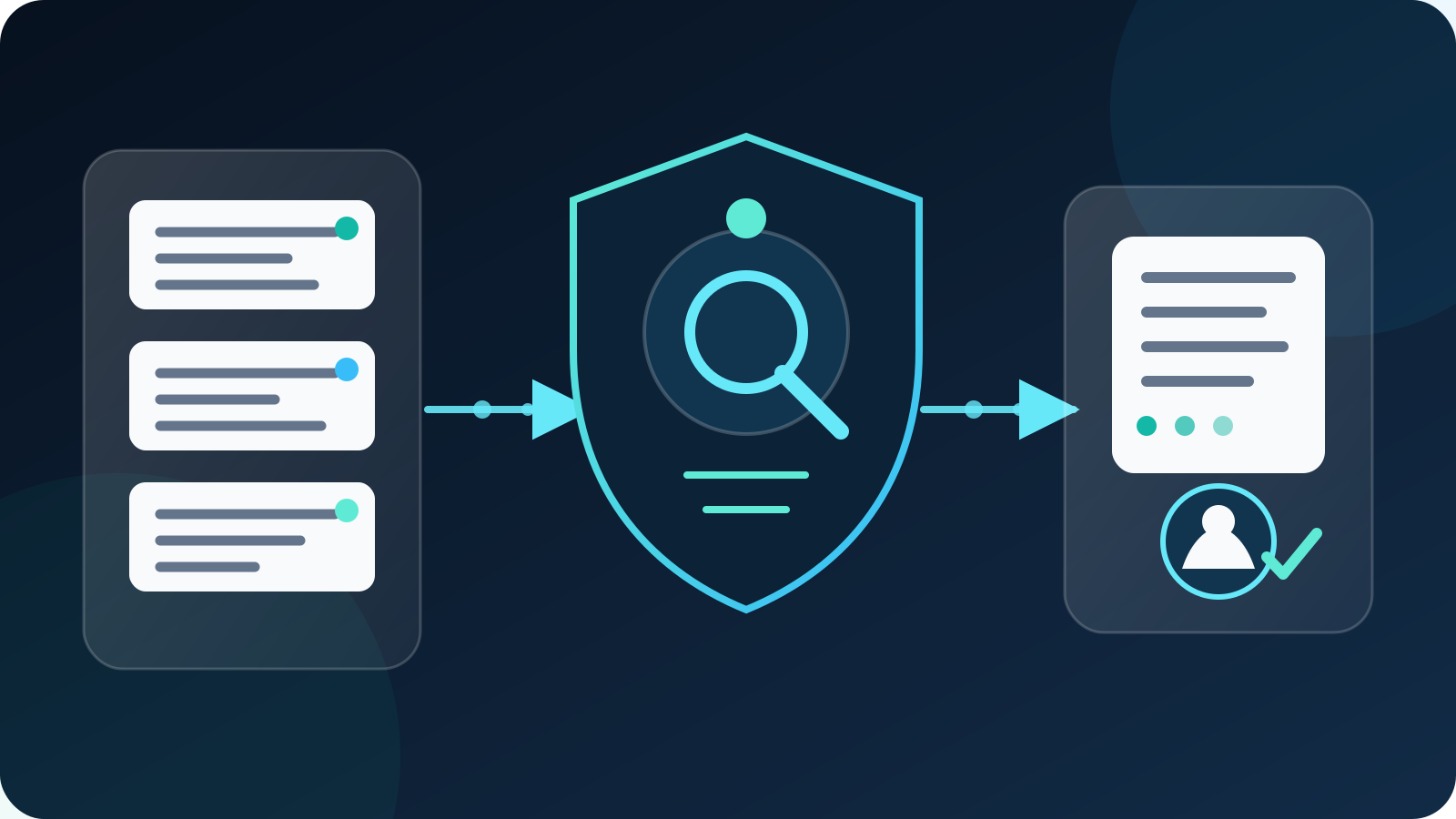
AI knowledge management helps staff find and use trusted business information across approved documents, systems and records. The best first project is a read-only assistant for one well-maintained knowledge collection. It should cite the exact source, respect existing permissions and send uncertain or sensitive questions to a named person.
The technology can shorten search and drafting time, but it cannot repair contradictory policies, unclear ownership or outdated files. Clean information and accountable review matter more than a clever chat interface.
Key takeaways:
- Start with one team, one repeated question type and a defined set of approved sources.
- Make every answer show the source document, passage, owner and review date.
- Preserve existing access controls instead of giving the assistant broad access.
- Separate finding information from approving a decision or changing a record.
- Measure answer accuracy, verification time, unanswered questions and source gaps.
Contents
- What is AI knowledge management?
- How does AI knowledge management work?
- Where can an AI knowledge system help?
- Which knowledge management project should you start with?
- What information should go into the system?
- How do you prevent confident but wrong answers?
- How should permissions and privacy work?
- How do you run an AI knowledge management pilot?
- How should you measure the result?
- When is AI the wrong choice?
- Frequently asked questions
What is AI knowledge management?
AI knowledge management is the use of artificial intelligence to find, organise and explain information held across a business. It can search policies, procedures, product material, project records and approved correspondence, then prepare an answer linked to its sources.
It is broader than an ordinary keyword search, but narrower than a general chatbot. A useful system works inside a defined information boundary and follows the permissions already attached to that information.
| Approach | What it does well | Main limitation |
|---|---|---|
| Folder and keyword search | Finds exact words and known filenames | Misses different wording and requires the user to inspect each result |
| Rules and filters | Applies fixed categories, dates and access conditions | Cannot interpret varied questions or document language |
| AI-assisted search | Matches meaning, summarises passages and drafts an answer | May combine weak evidence or sound certain when the source is incomplete |
| General AI chatbot | Handles broad questions and drafting | Does not automatically know which internal source is current or authorised |
For most businesses, the practical design combines these methods. Metadata and rules identify current, permitted records. Semantic search finds relevant passages. A language model explains those passages. The user sees the evidence and decides whether the answer is safe to use.
Australian businesses are still early in AI adoption. The Australian Bureau of Statistics reported that 12% of businesses used AI in 2024–25, up from 1% in 2021–22. Early adoption makes a narrow, measurable knowledge project more sensible than connecting every file at once.
How does AI knowledge management work?
A typical system retrieves relevant material before it writes an answer. This pattern is often called retrieval-augmented generation, or RAG. The name matters less than the controls around it.
A controlled workflow has six parts:
- Approved sources: selected folders, databases, help articles or business systems.
- Document processing: text is extracted and divided into passages that remain linked to the original record.
- Metadata: each passage keeps fields such as owner, version, review date, department and access group.
- Retrieval: the system matches a question with relevant permitted passages.
- Answer preparation: the model explains what the retrieved evidence says and cites it.
- Human action: a staff member checks the evidence before relying on it for a material decision.
The system should not search everything merely because it can. A sales employee asking about a product return policy may need the current public policy and an approved internal procedure. They do not need access to employee files, legal advice or another customer's records.
The answer also needs a clear failure mode. If the sources disagree, are out of date or do not support an answer, the system should say so and route the question to the content owner. A blank is safer than a plausible invention.
Where can an AI knowledge system help?
AI knowledge management works best where staff repeatedly search several approved sources and can verify the result quickly.
| Business task | Useful AI contribution | Human responsibility |
|---|---|---|
| Policy questions | Find the current policy and relevant clause | Interpret exceptions and approve any departure |
| Customer support | Retrieve product, service and process guidance | Confirm customer context and send the final response |
| Sales preparation | Gather approved product facts and standard answers | Check fit, claims and commercial terms |
| Employee onboarding | Answer routine questions from current procedures | Provide judgement, coaching and sensitive guidance |
| Project handover | Summarise decisions, dependencies and open actions | Confirm that records are complete and current |
| Technical support | Match symptoms with approved troubleshooting steps | Diagnose unusual cases and approve risky changes |
| Tender or proposal drafting | Retrieve approved capability and policy material | Verify accuracy and tailor commitments |
| Meeting follow-up | Connect decisions with related procedures and records | Confirm actions, owners and deadlines |
A useful assistant can also expose gaps. If people repeatedly ask a question that has no approved answer, that is a knowledge-management finding. The team can create or update the source instead of teaching the AI to improvise.
This is different from AI document automation, which moves a defined document through extraction, drafting or approval steps. Knowledge management focuses on finding and applying information across a governed collection. The two can connect, but they need different measures and controls.
Which knowledge management project should you start with?
For most Australian businesses, the best first project is a read-only internal assistant for one team's current procedures and frequently asked questions. It has a clear audience, bounded sources and answers that experienced staff can verify.
Choose a project that meets these conditions:
- staff ask the same type of question often
- the approved answer exists in identifiable records
- a source owner can resolve conflicts and expired material
- existing permissions can be preserved
- a wrong draft can be stopped before it affects a customer, employee or transaction
- the current search and verification time can be measured
A service team might begin with product guides, escalation rules and current process documents. The assistant could answer a question, quote the relevant passage and link to the source. It would not send a customer response, issue a refund or change an account.
A project team might instead use approved decisions, handover notes and operating procedures. The assistant could locate why a decision was made and identify its recorded owner. It should not infer a decision from informal chat when no approved record exists.
Avoid starting with a company-wide assistant across email, chat, cloud drives and every business system. That creates a large permission problem before the team has tested answer quality, ownership or user behaviour. Prove the design on one collection, then add sources deliberately.
What information should go into the system?
Include information that is useful, current, owned and permitted for the intended users. Exclude material simply copied for convenience without a clear purpose.
Create a source register before connecting anything:
| Source field | Question to answer |
|---|---|
| Business purpose | Which repeated question or task needs this source? |
| Owner | Who can confirm meaning and approve updates? |
| Authoritative version | Which record wins if duplicates disagree? |
| Review date | When was it last checked, and when is it due again? |
| Audience | Which roles may search or read it? |
| Sensitivity | Does it contain personal, confidential or legally privileged information? |
| Retention | How long should the record and derived index remain? |
| Removal path | How will deletion or access changes reach the search index? |
Prefer published procedures, approved templates, current product material and final decisions. Drafts, duplicate exports and abandoned project folders often create more confusion than value.
Do not treat every message as organisational knowledge. Email and chat can contain personal opinions, outdated instructions, customer information and unrecorded exceptions. If a conversation contains an important decision, move that decision into the approved system of record before asking an assistant to rely on it.
Metadata is part of the answer, not housekeeping. A policy passage without its version, owner and effective date may be impossible to trust. Keep those fields attached when documents are processed and indexed.
How do you prevent confident but wrong answers?
Require evidence, define refusal conditions and test realistic questions. A model that produces a fluent answer without adequate support has failed the task.
Use these controls:
- Limit retrieval to approved sources. Open-web results should not silently mix with internal policy.
- Show exact citations. Link to the document and relevant passage, not merely a folder or homepage.
- Prefer current authoritative records. Use version and status metadata before similarity alone.
- Set an evidence threshold. If retrieval is weak or conflicting, return no answer and name the owner.
- Separate fact from suggestion. Mark sourced information, generated explanation and recommended next steps distinctly.
- Test adversarial questions. Include false assumptions, expired policies, ambiguous names and requests for restricted records.
- Record corrections. Feed source problems to the owner rather than hiding them in prompt changes.
An answer can be factually accurate yet unsafe. For example, an old procedure may correctly describe a previous approval limit. Retrieval quality must include currency and authority, not only text similarity.
Create a test set before launch. It should include straightforward questions, questions with no answer, conflicting sources, permission boundaries and wording used by new staff. Experienced employees should identify the expected source and acceptable answer before seeing the system's response.
The Australian Government's guidance for AI adoption recommends an accountable owner for every AI system, testing before deployment, ongoing monitoring and clear human override points. Those practices fit knowledge systems because their answers change when source documents, permissions or models change.
How should permissions and privacy work?
The knowledge assistant should return only information the user could access directly. Search convenience must not become a new route around business permissions.
Apply access controls before retrieval, not after the answer is written. If a user cannot open a source document, its passages should not be considered for that user's answer. Hiding the citation after generation is too late because restricted details may already be present in the text.
Use separate collections or reliable permission filters for teams with different access. Test role changes, departures and revoked access. When a source is deleted or restricted, remove or update its indexed copy promptly.
Personal information needs specific care. The Office of the Australian Information Commissioner says privacy obligations apply to personal information entered into an AI system and AI output containing personal information. Its guidance recommends due diligence, privacy by design, human oversight and continuing review. It also recommends not entering personal information, especially sensitive information, into publicly available generative AI tools.
Before connecting a source, check:
- what personal or confidential information it contains
- why that information is necessary for the defined task
- where source text, indexes, prompts and logs are stored
- whether a supplier uses submitted data for model training
- who can inspect prompts, answers and feedback
- how deletion, correction and retention requirements are handled
- whether users know when they are interacting with AI
Minimise data at the source. An onboarding assistant may need approved workplace procedures, but it usually does not need employee performance files. A proposal assistant may need approved capability statements, but it does not need every customer's contract.
How do you run an AI knowledge management pilot?
Run the pilot beside the existing search process and keep it read-only. Use real questions, but do not let the assistant approve decisions or update source records.
- Define one question set. Name the team, use case, expected sources and excluded topics.
- Measure the baseline. Record search time, verification time, escalations and unanswered questions.
- Prepare the sources. Remove duplicates, identify owners, set review dates and confirm permissions.
- Build an answer test set. Include routine, ambiguous, unsupported, outdated and restricted questions.
- Set acceptance rules. Require the right source, correct passage, acceptable answer and proper refusal behaviour.
- Run with a small user group. Compare answers with the existing process for four to eight weeks.
- Review errors weekly. Separate retrieval failures, source failures, permission failures and user misunderstanding.
- Expand only from evidence. Add users or sources after the system passes the agreed measures.
Set stop conditions before launch. Pause the pilot if restricted information appears, citations disappear, deleted content remains searchable or staff begin treating answers as approvals.
Assign two owners. The system owner is responsible for configuration, access, testing and monitoring. The knowledge owner is responsible for source quality, conflicts and review dates. One person may hold both roles in a small business, but the responsibilities should still be explicit.
How should you measure the result?
Measure the full path from question to verified use. A fast answer that takes longer to check is not an improvement.
| Measure | What it shows |
|---|---|
| Time to first useful source | Whether retrieval is faster than the current search process |
| Verification time | Whether citations make the answer easy to check |
| Supported-answer rate | How often the system has enough approved evidence |
| Correct refusal rate | Whether it declines unsupported or restricted questions |
| Source accuracy | Whether the cited document and passage support the answer |
| Correction rate | How often users materially change the answer |
| Escalation rate | Which questions still need an experienced person |
| Source-gap count | Which repeated questions lack current approved guidance |
| Permission incidents | Whether any user receives information they should not access |
| Operating cost | Software, integration, content maintenance, review and support |
Do not optimise for the number of questions answered. A high answer rate can reward guessing. For most businesses, the better target is a high rate of correct, verifiable answers and correct refusals.
Track results by question type. Routine policy questions may perform well while unusual customer or contract questions do not. That difference should shape the system's scope.
When is AI the wrong choice?
AI is the wrong starting point when the source information is duplicated, contradictory, ownerless or rarely updated. Fix the knowledge process first.
Use ordinary search or navigation when staff already know the correct term and the collection is small. Use deterministic rules when an answer depends on an exact threshold, entitlement or approval. Use a qualified person when the question requires legal, financial, employment or safety judgement.
A small team may gain more from a single procedure library, consistent filenames and a monthly content review than from an AI assistant. Those foundations are not wasted work. They make any later search or automation safer.
AI is also a poor fit when users cannot inspect the source. If the system provides answers but cannot show where they came from, staff have no reliable way to verify currency, context or authority.
Where should an Australian business start?
Choose one team that spends measurable time searching current procedures or product information. Identify the authoritative sources, remove duplicates and test a read-only assistant that cites every answer.
Deployed AI provides managed AI systems that connect selected business tools, with setup, team training and ongoing Australian support. To assess one suitable knowledge workflow, book a free 30-minute AI audit.
Frequently asked questions
What is AI knowledge management?
AI knowledge management uses artificial intelligence to find, organise and explain information from approved business sources. A reliable system preserves permissions, identifies the current source and gives users citations they can verify.
What is the best first AI knowledge management project?
The best first project is usually a read-only assistant for one team's current procedures and frequently asked questions. It has a bounded audience, identifiable sources and answers that experienced staff can check before use.
Can AI replace a company knowledge base?
No. AI can improve how people search and use a knowledge base, but it still needs current, owned and well-structured source information. It cannot reliably resolve contradictory policies or invent missing organisational decisions.
How do you stop an AI knowledge base from making things up?
Restrict it to approved sources, require exact citations, prefer current authoritative records and make it refuse questions without enough evidence. Test unsupported, ambiguous, outdated and restricted questions before launch and throughout operation.
Is AI knowledge management safe for confidential information?
It can be used with confidential information only when access, storage, retention, supplier terms, logging and deletion are properly controlled. The system should retrieve information according to each user's existing permissions, and the business should minimise personal and sensitive data.