AI lead generation uses artificial intelligence to research markets, organise enquiries, qualify prospects and prepare personalised follow-up. For most Australian businesses, the best first use is not automated cold outreach. It is a controlled workflow that turns a real enquiry into a researched, prioritised and review-ready sales task.
A useful system should improve relevance and response time without guessing intent, inventing personal details or sending messages without a lawful basis. People remain responsible for the target market, offer, consent, claims and decision to contact each prospect.
Key takeaways:
- Start with inbound leads or an approved prospect list, not indiscriminate scraping.
- Use AI to research, classify and draft while people approve contact and commercial claims.
- Keep the source behind each fact, score and personalisation point visible.
- Build consent, opt-out and suppression checks before any message can be sent.
- Measure qualified opportunities and correction effort, not contacts collected or emails produced.
Contents
- What is AI lead generation?
- Where can AI help with lead generation?
- What is the best first AI lead generation workflow?
- How should AI qualify a lead?
- Can AI personalise outreach safely?
- What Australian privacy and spam rules apply?
- What data and controls does the system need?
- How do you run a controlled pilot?
- How should you measure the result?
- When is AI the wrong lead generation tool?
- Frequently asked questions
What is AI lead generation?
AI lead generation means using artificial intelligence to find patterns in market, customer and enquiry data, then prepare sales work. It can group enquiries, retrieve public business information, suggest qualification questions, draft account briefs and prepare follow-up for a salesperson to review.
The term is often used too broadly. It can describe anything from a website assistant that captures an enquiry to software that collects contact details and sends cold emails. Those uses have different risks and should not share one set of permissions.
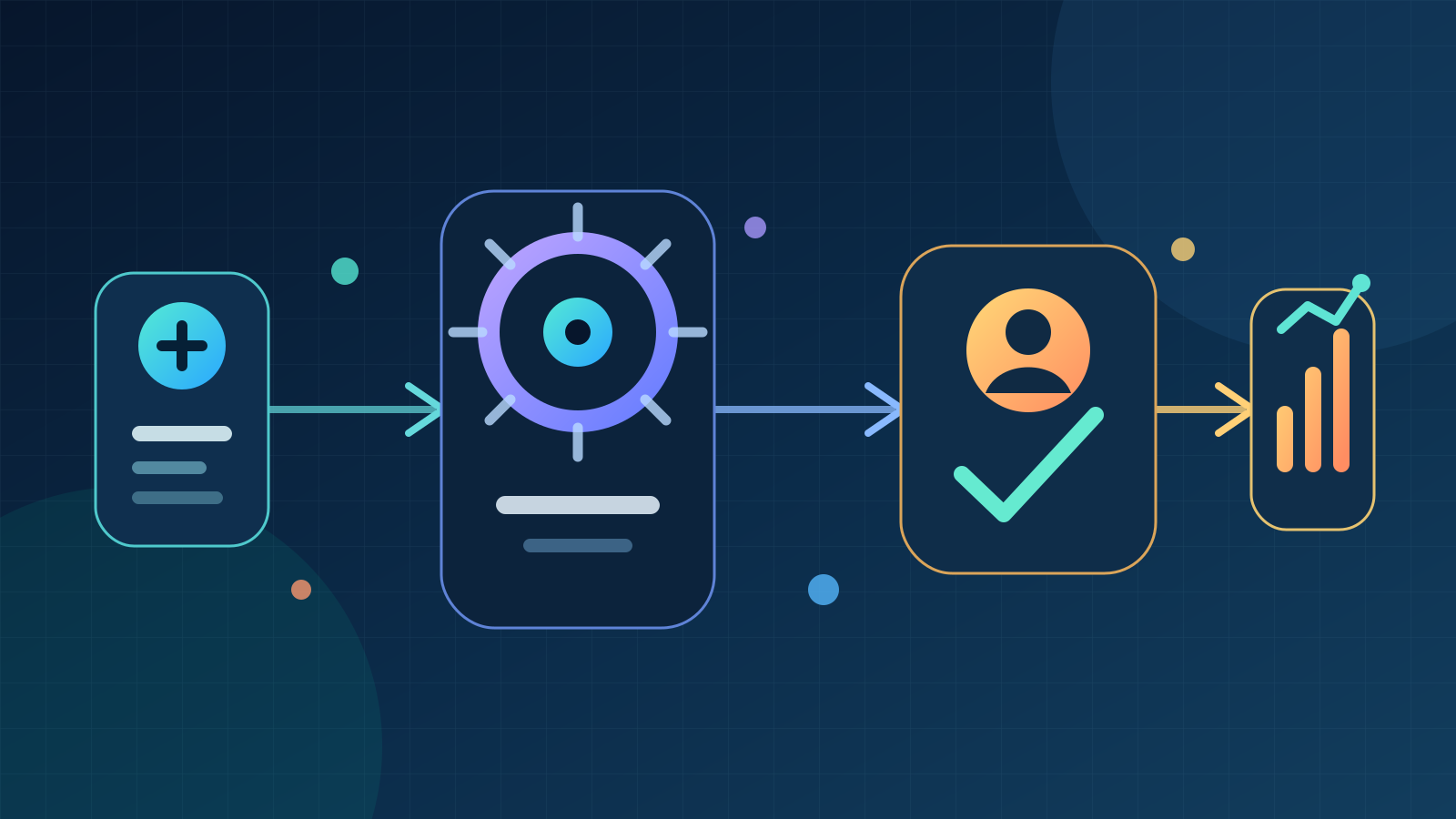
A practical lead generation process has four stages:
- Attract or identify interest. A person submits a form, attends an event, responds to a campaign or appears on an approved account list.
- Enrich the record. The system adds relevant business facts from named, permitted sources.
- Qualify the opportunity. Documented criteria determine whether the lead fits and what information is missing.
- Prepare the next action. AI drafts a brief or response, then an authorised salesperson reviews it.
AI is useful where language and context vary. Ordinary automation should still handle exact rules such as required fields, territory ownership, suppression lists and response deadlines.
Australian businesses are adopting AI, but measurement remains limited. The Australian Bureau of Statistics reported that 12% of businesses used AI in 2024–25. Only 7% measured the contribution of digital activities to overall business performance. Lead generation needs a baseline and an outcome measure, otherwise more activity can be mistaken for progress.
Where can AI help with lead generation?
AI can reduce research and administration when the business already knows whom it serves, what evidence supports the offer and how a lead should move through the sales process.
| Lead generation task | Useful AI contribution | Human responsibility |
|---|---|---|
| Enquiry triage | Identify topic, urgency and missing details | Confirm priority and ownership |
| Account research | Summarise approved public and internal sources | Verify material facts and relevance |
| Lead qualification | Apply documented criteria and explain gaps | Decide fit, exceptions and next action |
| CRM preparation | Suggest fields, tags and follow-up tasks | Approve changes and resolve conflicts |
| Follow-up drafting | Prepare a response from the enquiry and approved offer | Check consent, accuracy and tone before sending |
| List review | Flag duplicates, stale records and missing evidence | Decide whether a contact may be used |
| Campaign analysis | Group lead quality and source outcomes | Change targeting, offer or budget |
For most businesses, the useful pattern begins after a genuine signal. The system can read an enquiry, match it to the correct service, retrieve relevant information and prepare a response while the salesperson focuses on the conversation.
AI lead generation is narrower than AI for sales, which also covers meetings, proposals, CRM maintenance and forecasting. It overlaps with AI for marketing, but marketing usually works at audience and campaign level. Lead generation connects that activity to identifiable prospects and sales follow-up.
Avoid treating every website visitor or public contact as a lead. A record becomes commercially useful when the business has a legitimate reason to engage, enough evidence to assess fit and a clear next step.
What is the best first AI lead generation workflow?
For most Australian businesses, the best first workflow is inbound lead triage and researched follow-up. The lead has already contacted the business, the source is known and a salesperson can compare the AI output with the original enquiry.
A controlled workflow can:
- receive a form submission or approved sales inbox message
- check required contact and consent fields
- identify the product, service or problem mentioned
- retrieve relevant business facts from approved sources
- compare the enquiry with documented fit criteria
- list missing information rather than guessing it
- prepare an account brief and draft response
- route both to the correct salesperson
- record corrections, approval and outcome
This workflow is easier to test than automated prospecting because every case has a source message and an accountable reviewer. It also improves a customer-facing delay that the business can measure.
Start with one enquiry type. A managed service business might begin with website requests for an initial consultation. A wholesaler might use quote enquiries. A commercial property service might use maintenance requests that contain a genuine opportunity for a separate service.
Do not let the model decide price, availability or contractual terms. It may retrieve approved information and flag which details apply, but a person should confirm any commitment.
How should AI qualify a lead?
AI should qualify a lead by applying criteria the business has written down and showing the evidence for each result. It should not infer personality, financial capacity, urgency or buying intent from weak signals.
A simple qualification framework might cover:
- whether the prospect is in a market and location the business serves
- whether the stated problem matches an approved service
- whether the expected timing is known
- whether the likely decision process is understood
- whether required technical or operational conditions are present
- which information is missing before a useful conversation can occur
Use a small number of explainable categories such as ready for review, needs information, future nurture and not a current fit. A single hidden score creates false precision and makes mistakes harder to challenge.
Each classification should include:
- the criterion applied
- the source used
- the evidence found
- any conflicting information
- what remains unknown
- the person responsible for the decision
Historical sales data can support qualification, but it can also encode old targeting choices and inconsistent CRM habits. A model may learn that a group rarely became customers because the business rarely followed them up. Test for these circular patterns before using past outcomes as labels.
Keep low scores from becoming silent rejection. A salesperson should review unusual, high-value or strategically important cases. The system should also support “insufficient evidence” as a valid answer.
Can AI personalise outreach safely?
AI can personalise a message safely when it uses relevant, verified information and the recipient would reasonably expect the contact. Good personalisation explains why the message is useful. It does not expose how much information the sender has collected.
Safe inputs include:
- details the person supplied in an enquiry
- the current relationship recorded in the CRM
- verified facts about the prospect's business from an approved source
- the specific product, event or resource they asked about
- approved service facts, case material and next steps
Avoid personalising from inferred sensitive traits, private social activity, family details or unrelated data. Do not claim that a person has a problem merely because a model predicts it.
Keep the first draft short. A useful response acknowledges the real enquiry, answers what can be answered and asks for the missing information needed to proceed. It should not pretend the sender completed extensive personal research when they did not.
Every material claim needs a current source. The Australian Competition and Consumer Commission says business claims must be accurate, truthful and based on reasonable grounds. That applies to prices, benefits, performance, availability and delivery statements in AI-generated outreach as much as human-written sales material.
For outbound campaigns, review messages in small batches. Look for unsupported familiarity, repeated claims, incorrect company facts and language that could create pressure or confusion. A person should approve the target list and the final send.
What Australian privacy and spam rules apply?
AI does not remove the business's responsibility under privacy, spam and consumer law. The legal basis for collecting information and contacting someone needs to exist before automation begins.
The Australian Communications and Media Authority says businesses sending marketing emails or messages need consent, must identify themselves and must provide a way to unsubscribe. Its spam guidance states that express consent is best practice, the sender must be able to prove consent and a business remains responsible when using a purchased marketing list.
Do not treat a public email address as automatic permission to send marketing. Do not send an email asking for consent, because that request can itself be a marketing message. Keep evidence of who consented, when, how and for what channel or purpose.
The Office of the Australian Information Commissioner explains that APP 7 restricts the use and disclosure of personal information for direct marketing. Expectations, source of the information, consent and a simple opt-out process all matter. A person can also ask where the business obtained their information.
The OAIC says privacy obligations apply to personal information entered into an AI system and to generated output containing personal information. Its guidance recommends product due diligence, privacy by design, human oversight and continuing review. As a matter of best practice, it recommends not entering personal information into publicly available generative AI tools.
Build these controls into the workflow:
- confirm the permitted source and purpose for every contact record
- store consent evidence and channel preferences
- check suppression and unsubscribe lists before drafting and again before sending
- identify the business accurately in every message
- provide a clear, working opt-out
- pass opt-outs to every connected system promptly
- restrict access to the minimum personal information needed
- retain the source behind enriched facts and derived classifications
Rules differ by situation, industry and channel. Get appropriate advice when the intended use involves purchased lists, sensitive information, profiling or large-scale automated outreach.
What data and controls does the system need?
A useful AI lead generation system needs better boundaries, not more data. Give each component only the information and actions required for its task.
Start with an approved data map:
| Data or capability | Why it may be needed | Control |
|---|---|---|
| Enquiry content | Understand the stated need | Limit access to the relevant queue |
| Contact and company record | Match the lead and avoid duplicates | Use verified identifiers and proposed changes |
| Consent and suppression status | Determine permitted contact | Make this a mandatory pre-send rule |
| Approved offer information | Prepare accurate answers | Version sources and name an owner |
| Public business sources | Add relevant account context | Keep URLs and retrieval dates |
| CRM history | Avoid repeated or conflicting contact | Restrict to the assigned account |
| Email drafting | Prepare a response | Draft only during the pilot |
| Sending or CRM write access | Complete an approved action | Separate permission and explicit approval |
Prompt injection is a practical risk when the system reads websites, emails or documents. Treat external content as information to assess, not as authority to change instructions, reveal data or call tools. Validation rules and permission boundaries must enforce the workflow even when an input contains misleading directions.
Keep research facts separate from model inferences. Record the source, date and exact field that supports each material statement. If a source changes, staff should be able to identify affected briefs and drafts.
Use role-based access, multifactor authentication and activity logs. Confirm where prompts, files and outputs are stored, whether the provider uses them for training, how long they remain and how deletion reaches connected systems.
How do you run a controlled pilot?
Run one lead source for four to six weeks in draft-only mode. Keep the current process available while the team tests accuracy, consent checks and reviewer effort.
- Define the lead source. Choose one form, inbox or approved list with a clear owner.
- Record the baseline. Measure volume, response time, qualification rate, corrections and sales outcomes.
- Document the rules. Write the fit criteria, excluded contacts, permitted sources and approval boundary.
- Prepare test cases. Include incomplete forms, duplicate contacts, unsubscribed records, conflicting company facts and irrelevant enquiries.
- Start read-only. Let the system prepare a brief and response without changing CRM records or sending messages.
- Review every case. Record material errors separately from wording preferences.
- Test failure paths. Confirm the workflow stops when consent is missing, a source conflicts or required information is unavailable.
- Train the reviewers. Show them how to check sources, correct records and report a problem.
- Compare outcomes. Continue only if response and lead handling improve without weaker consent, accuracy or trust.
Set stop conditions before launch. Pause the workflow if it contacts a suppressed person, exposes restricted information, invents a material fact or bypasses approval.
Expansion should be earned. After inbound triage performs reliably, the business might add a second enquiry source or allow approved CRM updates. Unsupervised outbound sending should not be the automatic next step.
How should you measure the result?
Measure the commercial outcome and the work required to achieve it. Contacts found, words generated and emails sent are activity measures, not evidence of useful lead generation.
| Measure | What it shows |
|---|---|
| Time to first reviewed response | Whether a real enquiry receives attention sooner |
| Research time per lead | Whether account preparation is faster |
| Material correction rate | How often facts, fit or next steps are wrong |
| Leads needing more information | Whether the capture process supplies enough detail |
| Qualified meeting rate | Whether reviewed leads progress to a useful conversation |
| Opportunity rate | Whether meetings become genuine sales opportunities |
| Cost per qualified opportunity | Whether software, data and staff effort are economical |
| Unsubscribe and complaint rate | Whether outreach remains relevant and expected |
| Suppression or consent failures | Whether mandatory controls work |
| Revenue outcome by source | Which lead sources produce completed business over time |
Compare the pilot with the same lead source before the change. Account for season, campaign spend, offer changes and sales staffing. Otherwise the system may receive credit for a better promotion or a busier month.
Separate AI errors from process errors. Wrong company information may come from a stale source, bad record matching or an unsupported model inference. Each cause needs a different fix.
Use a quality threshold as well as a speed target. A faster response is not a win if staff correct more material details or prospects receive irrelevant contact.
When is AI the wrong lead generation tool?
AI is the wrong starting point when the business does not have a defined market, a useful offer or a consistent sales process. Faster prospecting cannot repair weak positioning.
Do not begin with AI when:
- contact sources and consent cannot be explained
- the CRM contains duplicates, stale owners or ignored opt-outs
- qualification relies on vague instinct rather than documented criteria
- the system would infer sensitive traits or personal circumstances
- nobody checks claims, company facts or account matching
- the first version needs broad scraping and autonomous sending
- the team cannot measure opportunities and completed sales by source
A better form, clearer offer or ordinary CRM rule may solve the immediate problem. For example, requiring company size and service location on a form may improve routing without AI.
AI is also a poor fit for tiny lead volumes where a salesperson can review every case quickly. The setup, data controls and monitoring may cost more than the administration saved.
The best system creates fewer, better-prepared conversations. If the strategy depends on sending more low-relevance messages, fix the strategy first.
Where should an Australian business start?
Review the last 50 enquiries from one source. Record response time, missing information, research effort, qualification decision and outcome. That sample becomes both the baseline and the first test set.
Build a draft-only workflow that shows its sources and applies consent and suppression rules before it prepares any message. Keep a salesperson responsible for fit, claims and sending.
Deployed AI provides managed AI systems that connect selected business workflows with permissions, testing, team training and ongoing Australian support. To assess one lead generation workflow, book a free 30-minute AI audit.
Frequently asked questions
What is AI lead generation?
AI lead generation uses artificial intelligence to research markets, organise enquiries, qualify prospects and prepare follow-up. It works best when the business provides approved data, documented criteria and human review before any external message or commercial commitment.
What is the best first AI lead generation use case?
Inbound lead triage and researched follow-up is usually the best first use case. The enquiry source is known, the AI output can be checked against the original message and a salesperson can approve the response before it is sent.
Is AI lead generation legal in Australia?
AI lead generation can be used in Australia, but the business still needs to comply with privacy, spam, consumer and other applicable laws. Consent, the source and purpose of personal information, sender identification, opt-out handling and accurate claims all need to be built into the process.
Can AI send cold emails automatically?
Technically it can, but automatic cold outreach creates consent, accuracy, reputation and quality risks. Start with draft-only messages to recipients the business has a permitted reason to contact, then require a person to approve the list, claims and final send.
How much does AI lead generation cost?
Cost depends on data sources, CRM and email connections, user numbers, model use, security controls, testing and ongoing review. Compare the full cost with qualified opportunities and completed sales, including staff correction time and data fees.