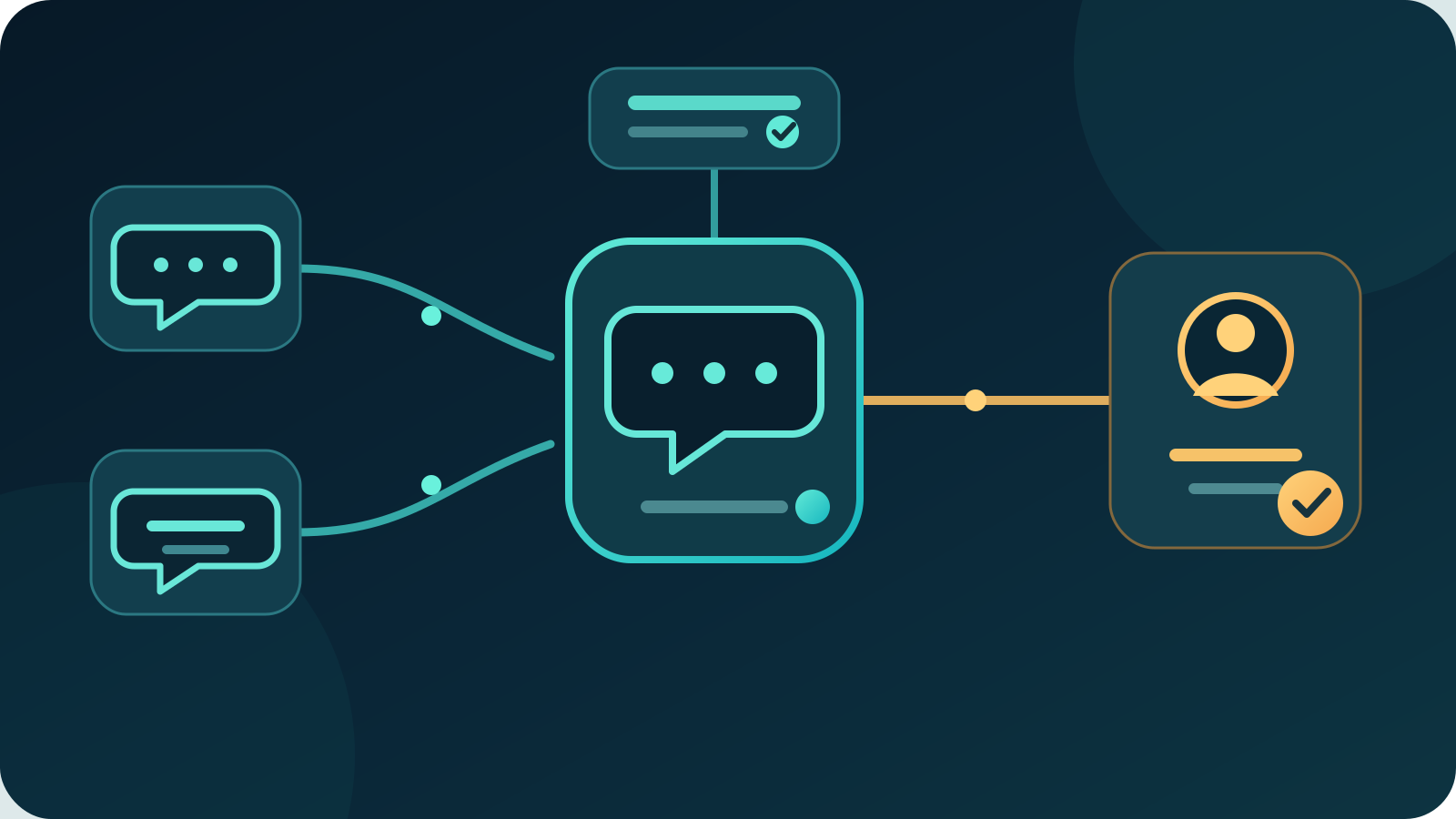
An AI chatbot for business answers written questions through a website, app or messaging channel using approved business information. For most Australian businesses, the best first chatbot handles one narrow group of routine enquiries, clearly identifies itself and offers an immediate path to a person. It should not invent policies, make sensitive decisions or hide human support.
Start with a low-risk workflow such as service-area questions, booking enquiries or order-status triage. Keep the chatbot read-only during the pilot, test it against real customer wording and measure correct outcomes rather than conversations contained.
Key takeaways:
- Give the chatbot one defined job and a maintained source of truth.
- Make AI use clear and let customers ask for a person at any point.
- Separate answering questions from taking actions in business systems.
- Keep complaints, disputes, sensitive matters and exceptions with people.
- Measure accuracy, handover quality, repeat contact and correction work.
Contents
- What is an AI chatbot for business?
- What can a business chatbot do?
- How is a chatbot different from an AI agent?
- What is the best first chatbot use case?
- How should you compare chatbot options?
- What information should a chatbot use?
- How do privacy and consumer rules apply?
- How should human handover work?
- How do you test an AI chatbot?
- How should you measure chatbot performance?
- What does an AI chatbot cost?
- When is a chatbot the wrong choice?
- Where should an Australian business start?
- Frequently asked questions
What is an AI chatbot for business?
An AI chatbot for business is a text-based system that interprets a customer's message, retrieves relevant information and prepares a conversational reply. It usually appears on a website, inside an app or in a supported messaging channel.
A useful business chatbot combines:
- a chat interface
- an approved knowledge source
- instructions defining what it may answer
- identity and permission checks where account data is involved
- integrations for tightly controlled actions
- human handover and failure rules
- conversation logs for review
The chat window is the simple part. The quality depends on the information, permissions and operating rules behind it.
Australian keyword research for this guide found about 70 monthly searches for “AI chatbot for business”, with low advertising competition and a reported cost per click of $58.59. Search results mix software lists, provider pages and general guides. Buyers still need practical criteria for Australian privacy, truthful customer communications and safe handover.
What can a business chatbot do?
A business chatbot works best when the request is common, the answer can be checked and the consequence of an error is limited.
| Chatbot task | Useful contribution | Human responsibility |
|---|---|---|
| General enquiries | Answer from current website and service information | Maintain the approved source |
| Lead capture | Collect contact details and qualifying information | Confirm fit, price and follow-up |
| Booking enquiry | Show available options or gather a request | Handle exceptions and confirm changes |
| Order or job status | Retrieve a status after identity checks | Resolve delays, disputes and missing records |
| Support triage | Identify the issue and route it to the right queue | Review unusual or high-impact cases |
| Product guidance | Explain documented features and selection criteria | Check recommendations and regulated claims |
| Document requests | Send an approved public document or create a staff task | Confirm access to restricted records |
| Internal staff help | Find procedures and prepare an answer | Apply judgement and approve the action |
The first version does not need to complete every task. A chatbot can create value by collecting structured details and sending the conversation to the right person.
A chatbot is one channel within a wider AI customer service approach. Customer service AI may also sort email, draft replies, summarise tickets and analyse recurring issues. Build a chatbot when live written conversation is the problem to solve, not simply because chat software is available.
How is a chatbot different from an AI agent?
The main difference is authority. A chatbot talks with a person. An AI agent may also decide which steps to take and use connected tools to carry them out.
| Option | Main role | Suitable starting point | Main risk |
|---|---|---|---|
| Rules-based chatbot | Follow fixed menus and answers | Opening hours, contact routing and simple forms | Rigid conversations and dead ends |
| AI knowledge chatbot | Answer varied questions from approved content | Website enquiries and internal procedures | Unsupported or outdated answers |
| AI chatbot with actions | Answer and complete selected tasks | Booking requests or lead creation | Wrong or unauthorised system changes |
| AI agent | Plan and perform multi-step work across tools | Mature, tightly governed workflows | Wider consequences when a step fails |
| Human live chat | Manage varied conversations requiring judgement | Complaints, negotiation and sensitive matters | Staffing and response-time cost |
For most businesses, the best option is an AI knowledge chatbot with a strong handover path. Add actions only after the answer-only version performs reliably.
Do not use “agent” as a reason to grant broad access. Reading approved service information is different from changing a booking, issuing a refund or updating a customer record. Each action needs a separate permission, validation rule and audit trail.
What is the best first chatbot use case?
For most Australian businesses, the best first use case is website enquiry triage for one service line. It gives visitors a fast response while keeping qualification, pricing and commitments with staff.
A narrow first workflow can:
- identify itself as an AI assistant
- ask what the visitor needs
- answer basic service, location and process questions
- collect only the details needed for follow-up
- detect unsupported, sensitive or urgent requests
- offer a person or callback without resistance
- create a structured lead or support task
- show an honest response timeframe
- log the outcome for review
Choose a workflow with enough repeated conversations to evaluate. The source material should be current, the owner should be named and the failure path should be clear.
Avoid a launch goal such as “answer every website question”. That encourages broad scope and weak controls. Use a measurable goal such as “correctly answer or route service-area and booking enquiries without increasing repeat contact”.
How should you compare chatbot options?
Compare chatbot products using your own questions and failure scenarios. A polished demonstration based on vendor content does not prove the product can work with your policies, customers or systems.
| Criterion | Questions to ask |
|---|---|
| Knowledge control | Which sources can it use, cite and exclude? |
| Accuracy controls | What happens when sources conflict or the answer is missing? |
| Handover | Can a customer request a person at any time? |
| Identity | How is a customer verified before account details are shown? |
| Permissions | Can reading, drafting and changing records be separated? |
| Privacy | Where are messages, prompts and logs processed and stored? |
| Training use | Can the provider use business or customer data to train models? |
| Administration | Are roles, change history, logs and an emergency stop available? |
| Channels | Does the same controlled knowledge work across required channels? |
| Accessibility | Can people use the chat with keyboards, screen readers and mobile devices? |
| Monitoring | Can failed answers be grouped by topic, source and workflow version? |
| Exit | Can the business export conversations, configuration and source mappings? |
Ask each provider to show uncertainty. Remove a source, enter conflicting information, misspell a product and ask for a prohibited action. The chatbot should stop, explain the limit and hand over cleanly.
A provider should also explain the full cost. Per-conversation pricing may look cheap until model usage, integrations, support, reporting and staff review are included.
What information should a chatbot use?
A chatbot should use a small, approved set of information that has an owner and review date. More data does not automatically produce better answers.
Map each source before connection:
- Public information: services, locations, opening hours and published policies
- Knowledge articles: approved answers, troubleshooting and process explanations
- Customer records: only fields needed after an identity check
- Operational systems: booking, order or job status from the system of record
- Permissions: separate rights to read, create, update and send
- Freshness: the person responsible for each source and update timeframe
- Retention: how long messages, summaries and logs are kept
- Evidence: the source that supported each answer or action
Remove duplicated and expired content first. If two policy pages give different cancellation terms, the chatbot should not choose one. A person needs to resolve the source conflict.
Keep sensitive data out of the initial pilot. A public website chatbot rarely needs full access to payment details, staff files or every CRM field. Give it the minimum data needed for the defined task.
How do privacy and consumer rules apply?
A chatbot may collect names, contact details, account information, conversation history and inferred intent. Privacy and truthful communication need to be designed into the workflow.
The Office of the Australian Information Commissioner found that 84% of Australians want more control and choice over the collection and use of personal information. Its 2023 Australian Community Attitudes to Privacy Survey also found that only 32% felt in control of their data privacy. The survey covered a nationally representative sample of 1,916 adults.
Before launch, document:
- what the chatbot collects and why
- when it identifies itself as AI
- which provider and systems process the information
- where data is processed and stored
- who can access conversations and logs
- how long records are retained
- whether data can be used for model training
- how a customer can reach a person, correct information or complain
Review chatbot replies as business communications. The ACCC says claims about products and services must be accurate, truthful and based on reasonable grounds. It does not matter whether a business intended to mislead. A chatbot should not invent availability, conceal conditions, promise an unsupported result or give the wrong impression about a customer's rights.
The Australian Government's Voluntary AI Safety Standard sets out 10 guardrails for organisations. Relevant chatbot controls include accountability, risk management, data governance, testing, human oversight, transparency and a way for affected people to challenge an outcome.
How should human handover work?
Human handover should be visible, quick and useful. Do not force a customer to repeat the same question in different wording before offering help.
Escalate when the conversation involves:
- a complaint, dispute or request for compensation
- a vulnerable or distressed person
- safety, legal, financial or other professional advice
- identity uncertainty or sensitive account information
- a refund, cancellation or contract change
- conflicting, missing or outdated business information
- repeated misunderstanding
- an unsupported language or accessibility need
- any direct request for a person
Pass the original messages, verified details, a short summary and the reason for escalation to the staff member. State an honest response time if live help is unavailable.
Test the handover outside normal hours. A button labelled “talk to a person” is misleading if it leads to an unmonitored queue with no expected response time.
How do you test an AI chatbot?
Build the test set from real enquiries, known exceptions and the promises the business cannot afford to get wrong.
Test at least these conditions:
- common questions written in different ways
- spelling mistakes, abbreviations and ambiguous language
- questions with no answer in the approved source
- conflicting or expired source information
- requests for prices, availability or guarantees
- attempts to reveal hidden instructions or restricted data
- identity failures and requests about another person's account
- complaints, abusive messages and vulnerable customers
- direct requests for a person
- disconnected integrations and unavailable staff
- mobile, keyboard and screen-reader use
Review the visible reply, retrieved source, system action and handover together. A friendly answer can still be wrong, unsupported or attached to the wrong customer.
Start in a test environment, then run a limited live pilot. Keep actions read-only or draft-only. The Government's AI guardrails recommend measurable acceptance criteria, documented testing and ongoing monitoring. Apply those controls to the whole chatbot, including integrations and handover.
Set stop conditions before launch. Pause the chatbot if it exposes restricted information, invents a material fact, makes an unauthorised change, blocks a human request or repeatedly fails the same enquiry type.
How should you measure chatbot performance?
Measure correct customer outcomes and the work created for staff. Conversation volume alone does not show value.
| Measure | What it shows | Watch for |
|---|---|---|
| Correct-answer rate | Share of answers supported by current sources | Fluent answers with weak evidence |
| Appropriate handover | Whether risky and unsupported chats reach people | High containment caused by blocked escalation |
| First-contact resolution | Share resolved without another contact | Incorrect chats marked as complete |
| Repeat contact | Customers returning about the same issue | Work moving to email or phone |
| Manual correction | Staff effort needed to fix summaries or records | Small edits hiding serious errors |
| Lead quality | Enquiries that fit and include useful details | More leads with poor qualification |
| Customer satisfaction | Customer view of the completed interaction | Low survey response or channel bias |
| Cost per correct outcome | Full cost of an accurate resolution | Excluding maintenance and review time |
Review results by topic. A strong overall score can hide repeated failure on cancellations, pricing or account access.
Compare the pilot with a baseline. If correct outcomes do not improve, reduce the scope, fix the source information or choose a simpler form, search tool or live-chat process.
What does an AI chatbot cost?
AI chatbot cost usually includes setup, software, model usage, integrations, knowledge cleanup, testing, monitoring and staff support. Pricing may be per conversation, message, user, model token or connected channel.
Ask for a written estimate covering:
- conversation design and source preparation
- website or messaging-channel installation
- model and platform usage limits
- CRM, booking or support integrations
- privacy, identity and permission controls
- test design and launch review
- reporting and failed-conversation analysis
- source updates and workflow changes
- support, outage handling and data export
Compare cost per correct outcome, not cost per chat. Include the time staff spend reviewing leads, correcting records, handling escalations and updating information.
A searchable FAQ, structured form or human live-chat service may cost less when enquiry volume is low or most conversations require judgement.
When is a chatbot the wrong choice?
A chatbot is the wrong first step when information is inconsistent, customers need empathy or the business has no person responsible for handover.
Do not begin with:
- emergency or crisis conversations
- complaints and vulnerable customers
- legal, medical or financial advice
- disputed payments or contract decisions
- unrestricted access to sensitive customer records
- binding quotes based on incomplete information
- workflows with no reliable source or staff owner
It is also the wrong tool for a fixed interaction that a form can handle more clearly. If customers only need to choose a service, enter contact details and request a time, a well-designed form may be faster and easier to test.
Fix the service process before automating it. If staff cannot agree on the answer, escalation rule and owner, the chatbot will reproduce that uncertainty at scale.
Where should an Australian business start?
Review two to four weeks of website enquiries, live chats and contact forms. Group them by topic, frequency, handling time, risk and outcome. Choose one repeated category with current information and a straightforward handover.
Write a one-page chatbot policy. Include approved sources, disclosure, data collection, prohibited claims, permissions, escalation triggers, response times and the person accountable for results. Test that policy manually before selecting software.
Deployed AI builds managed AI systems with scoped connections, testing, team training and ongoing Australian support. To assess one chatbot workflow, book a free 30-minute AI audit.
Frequently asked questions
What is an AI chatbot for business?
An AI chatbot for business is software that answers written questions through a website, app or messaging channel using approved business information. A well-designed chatbot has a defined purpose, limited permissions, clear disclosure and a direct path to human help.
What is the best AI chatbot for a small business?
For most small businesses, the best chatbot is the one that answers one repeated group of questions accurately, works with maintained information and hands exceptions to a person. Broad features matter less than source control, easy administration, privacy settings and reliable handover.
Should customers be told they are talking to AI?
Yes. Clear identification sets the right expectation and helps customers make an informed choice about what they share. Explain the chatbot's purpose in plain language and make human support easy to reach.
Can an AI chatbot access customer records?
It can access selected customer data after an appropriate identity check, but access should be limited to the fields needed for the task. Separate reading information from changing records, and keep logs of every retrieval and action.
How long should a chatbot pilot run?
Run the pilot long enough to cover normal questions and meaningful exceptions, often four weeks when traffic is sufficient. Review failed conversations frequently and pause the system if privacy, accuracy, claims or escalation controls break.